SHT30 Humidity Reads Low After Reflow Soldering: Recovery, PCB Cleaning and FHT30 Qualification
A low reading immediately after reflow is not automatically a failed sensor. Production must distinguish a temporary recovery trend from contamination, local temperature error and permanent damage.
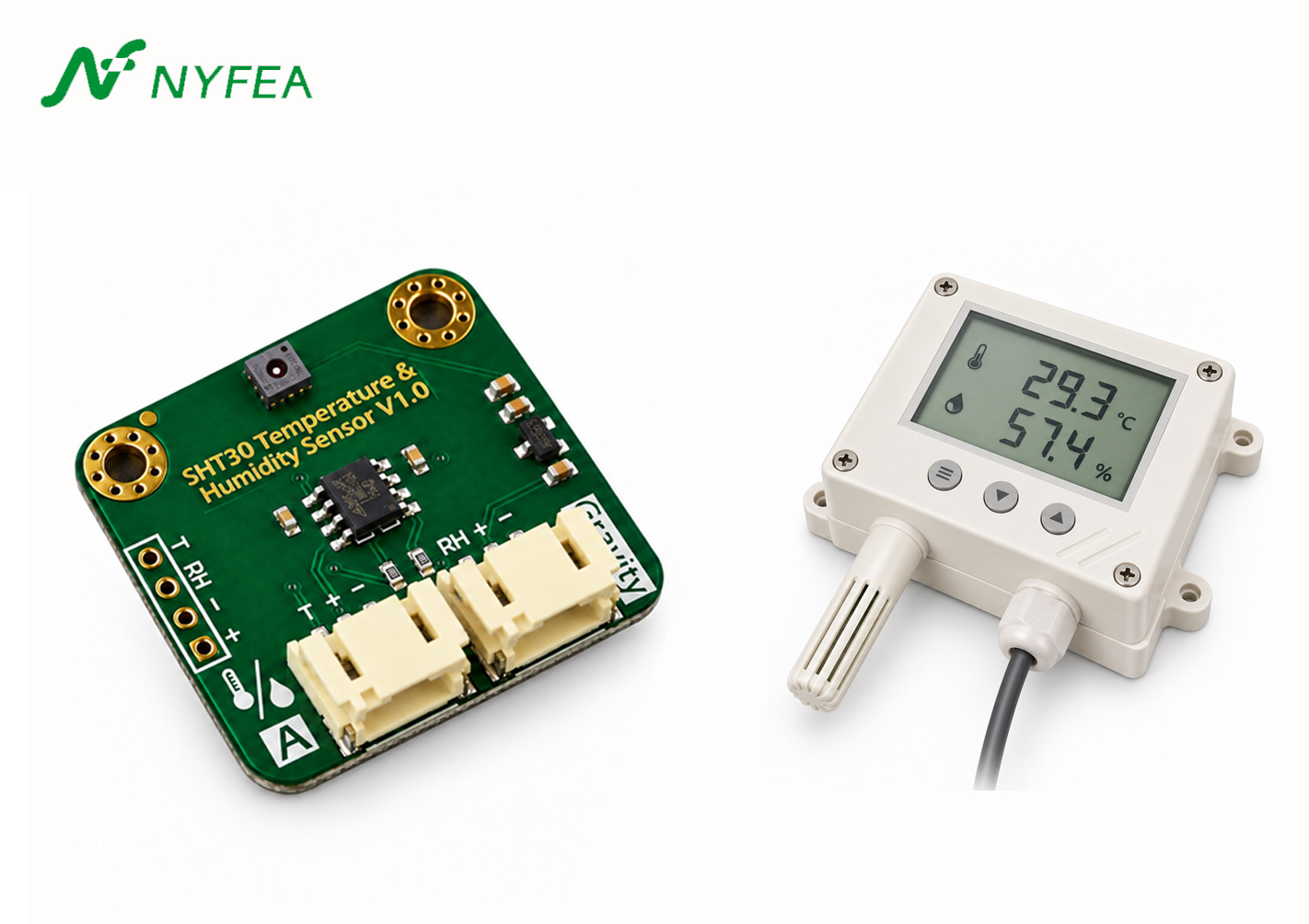
Why can SHT30 humidity read low after reflow soldering?
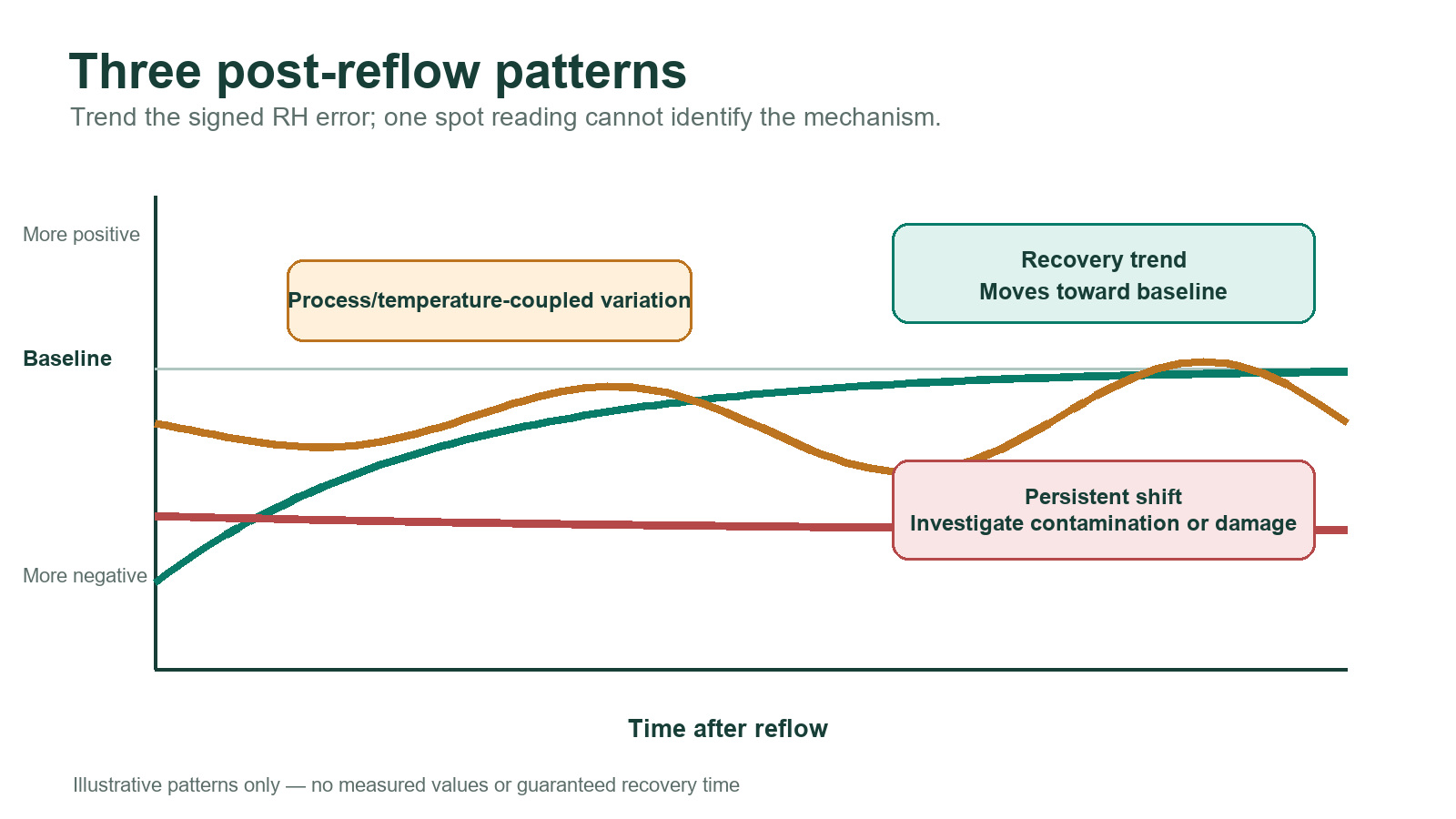
An SHT30 that reads low immediately after reflow is not automatically defective. Sensirion describes a typical temporary offset of −1 to −2 %RH after high-temperature exposure, with recovery typically taking one to three days in ambient conditions. These are typical observations, not guaranteed recovery limits. [1]
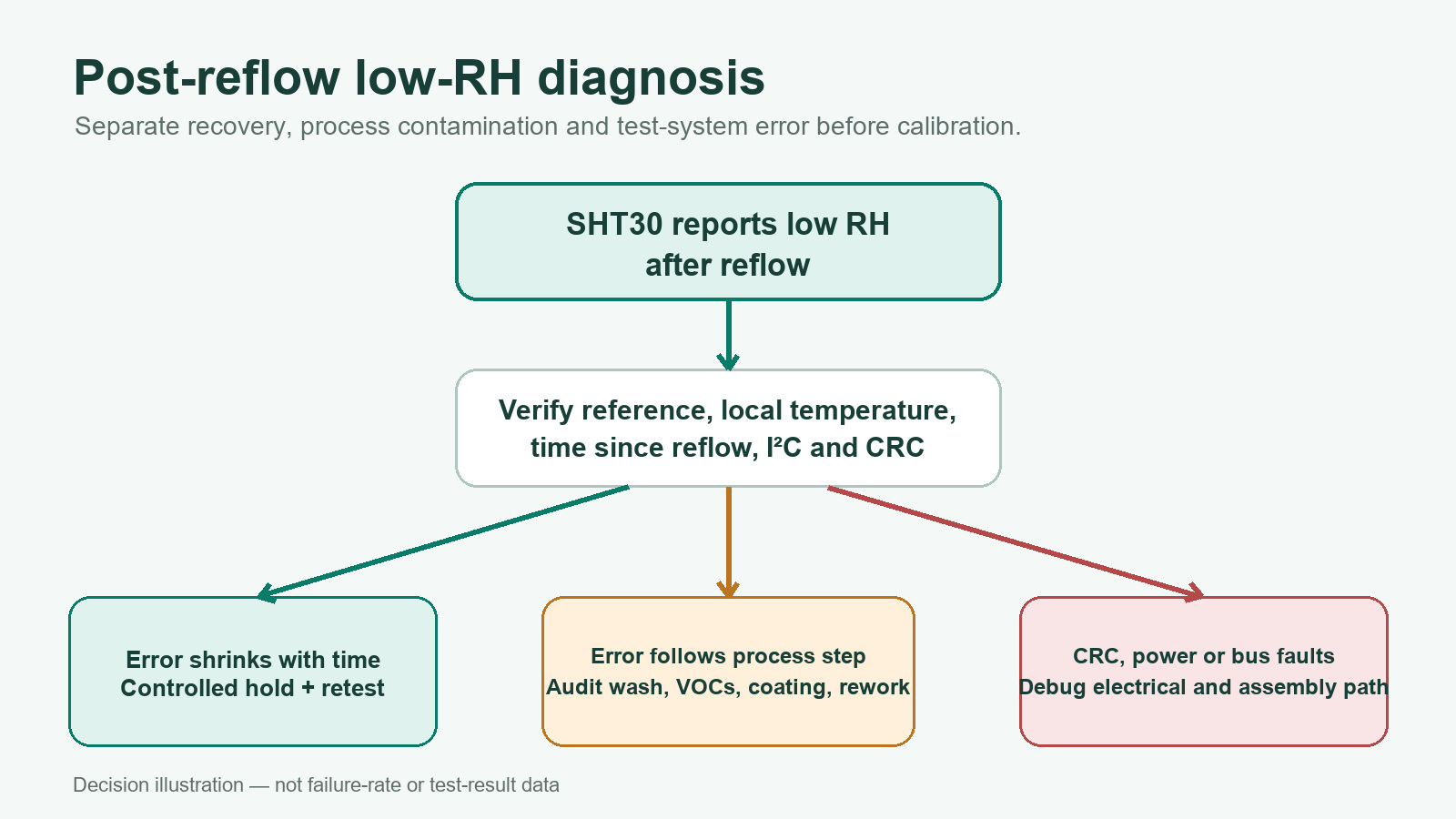
Hold calibration constant and trend signed error against a stable reference. A recovering error points toward a temporary post-reflow condition. A persistent or process-linked error requires investigation of board wash, cleaning chemicals, flux, adhesives, coating, packaging, excess thermal exposure and the test setup.
%RH error means a difference in relative-humidity percentage points. As an arithmetic example, 49 %RH against a 50 %RH reference is −1 %RH. The cited recovery guidance applies to Sensirion SHTxx, not FHT30.
How do you tell temporary SHT30 offset from contamination or damage?
A post-reflow SHT30 error can come from several mechanisms. A temporary negative shift may recover as the sensing system returns to equilibrium. Chemical contamination may persist or vary by lot and process step. A warm PCB or incomplete cooldown can also lower reported relative humidity because the sensor and reference are not at the same temperature.
| Observed pattern | Plausible mechanism | Discriminating check | Production response |
|---|---|---|---|
| Error shrinks during controlled ambient storage | Temporary post-reflow offset | Trend signed RH error from the first test through the hold window | Define a controlled hold and retest rule from line data |
| Error persists or grows | Chemical contamination or damage | Compare lots, materials, cleaning, coating and rework history | Stop release and trace the exposure source |
| Error changes with power or enclosure state | Local temperature or airflow bias | Log DUT and reference temperature beside RH | Correct placement or thermal coupling before calibration |
| CRC, timeout or reset faults also appear | Electrical, timing or assembly fault | Retain raw frames, CRC, supply and logic traces | Debug communication separately from RH offset |
The table is a triage method, not a universal acceptance specification. Product limits must come from the finished product's error budget and verified manufacturing capability.
Which production records should be retained before retesting?
An SHT30 recovery investigation is useful only when the manufacturing history can be reconstructed. Retain the exact order code and lot, board serial number, paste and flux, measured reflow profile, oven lane, panel position, solder-cycle count, rework history, cleaning or coating process, packaging exposure and time from oven exit to each measurement.
The test record also needs temperature, relative humidity (RH), airflow, reference identity, raw sensor words, cyclic redundancy check (CRC) results and firmware revision. CRC checks data integrity; a valid frame does not establish humidity accuracy. Retain both RH and temperature CRC results in the acquisition log. [2]
Record the heater state as well as the reflow history. The SHT3x heater is intended for plausibility checking and changes the local sensor temperature; keep it off during the ambient accuracy comparison. [2]
How should SHT30 post-reflow recovery be tested?
Compare each SHT30 device under test (DUT) with a characterized reference over time. First record an incoming baseline where available, then use the same measurement conditions after assembly.
- Verify the fixture. Allow the board and reference to reach thermal equilibrium. Use consistent airflow, spacing, power and enclosure state; keep the reference clear of warm PCB surfaces and oven exhaust.
- Capture the first practical checkpoint. Record elapsed time since oven exit rather than labeling the sample only “post-reflow.”
- Retest at planned checkpoints. For example, 24-hour and 72-hour measurements can show direction; they are observation points, not promised recovery deadlines.
- Track signed error. Use
RH_DUT − RH_referencefor every unit. A lot average can hide outliers and process-position failures. - Keep calibration fixed. Do not mask a changing recovery curve with a new software offset.
- Compare units, lots and positions. Retain failed samples without cleaning or rework until the cause review is complete.
A credible recovery report shows individual trajectories, the lot distribution, communication failures and missing checkpoints. If the observed change is comparable to reference uncertainty or fixture variation, report it as inconclusive rather than declaring recovery.
Track two different quantities: error = RH_DUT − RH_reference describes the current reading; shift = error_after − error_before describes the assembly-related change, provided both measurements use comparable RH and temperature conditions. Recovery toward the incoming baseline and compliance with the finished-product limit are separate decisions.
If SHT30 remains low at 72 hours: check the elapsed-time record, reference stability, temperature difference and process history before deciding on disposition. A 72-hour checkpoint alone proves neither permanent failure nor acceptable performance. Keep out-of-limit units on hold; a software correction or undocumented extra wait is not evidence of a controlled process.
Minimal code to calculate signed RH error at every checkpoint
The Python 3 function below keeps the supplied measurement record, adds signed RH and temperature error, and flags CRC failures, unverified CRC and invalid data. Only eligible_for_review rows belong in accuracy statistics; retain the other rows in the failure count.
View the core calculation and data checks
import math

def analyse(row):
    result = dict(row, rh_error_pct="", temp_error_c="")
    crc = (row.get("crc_ok") or "").strip().lower()
    if crc != "true":
        result["analysis_status"] = (
            "crc_failed" if crc == "false" else "crc_unverified"
        )
        return result  # Keep the row; exclude it from accuracy statistics.
    try:
        fields = ("hours_since_reflow", "rh_dut_pct", "rh_reference_pct",
                  "temp_dut_c", "temp_reference_c")
        elapsed, rh, ref_rh, temp, ref_temp = [float(row[k]) for k in fields]
        if not all(math.isfinite(v) for v in (elapsed, rh, ref_rh, temp, ref_temp)):
            raise ValueError("Non-finite measurement")
        if elapsed < 0 or not (0 <= rh <= 100 and 0 <= ref_rh <= 100):
            raise ValueError("Invalid time or RH range")
        if not all((row.get(k) or "").strip() for k in ("serial", "lot", "process")):
            raise ValueError("Missing traceability")
    except (KeyError, TypeError, ValueError):
        result["analysis_status"] = "invalid_or_missing_data"
        return result
    result.update(analysis_status="eligible_for_review",
                  rh_error_pct=round(rh - ref_rh, 2),
                  temp_error_c=round(temp - ref_temp, 2))
    return result  # Eligibility is not a production pass.
Record RH as 0–100, temperature in °C and elapsed time in hours. Set crc_ok=true only when both measurement CRCs pass in the acquisition software. The function trusts that flag; it does not recalculate CRC from raw bytes. eligible_for_review confirms basic data checks, not thermal stability, reference validity or product acceptance.
When is contamination more likely than temporary recovery?
Contamination deserves closer investigation when RH error clusters around a material or process step after reference and thermal effects have been checked. Sensirion identifies solvents, outgassing adhesives and packaging among possible sources of increased drift. Persistent negative error alone does not identify the contaminant. [2]
Do not wash the assembled SHT30 as a troubleshooting shortcut. Sensirion's handling guide specifies no board wash and recommends no-clean solder paste. It also recommends placing the sensor in the last solder cycle on boards requiring multiple cycles. Quarantine suspect samples with their records before cleaning or reworking can alter the evidence. [1]
For conformal coating, keep the sensing opening clear and control curing and ventilation. A coating that feels dry may still be short of its specified full cure. Audit the material, mask and cure history together. [1]
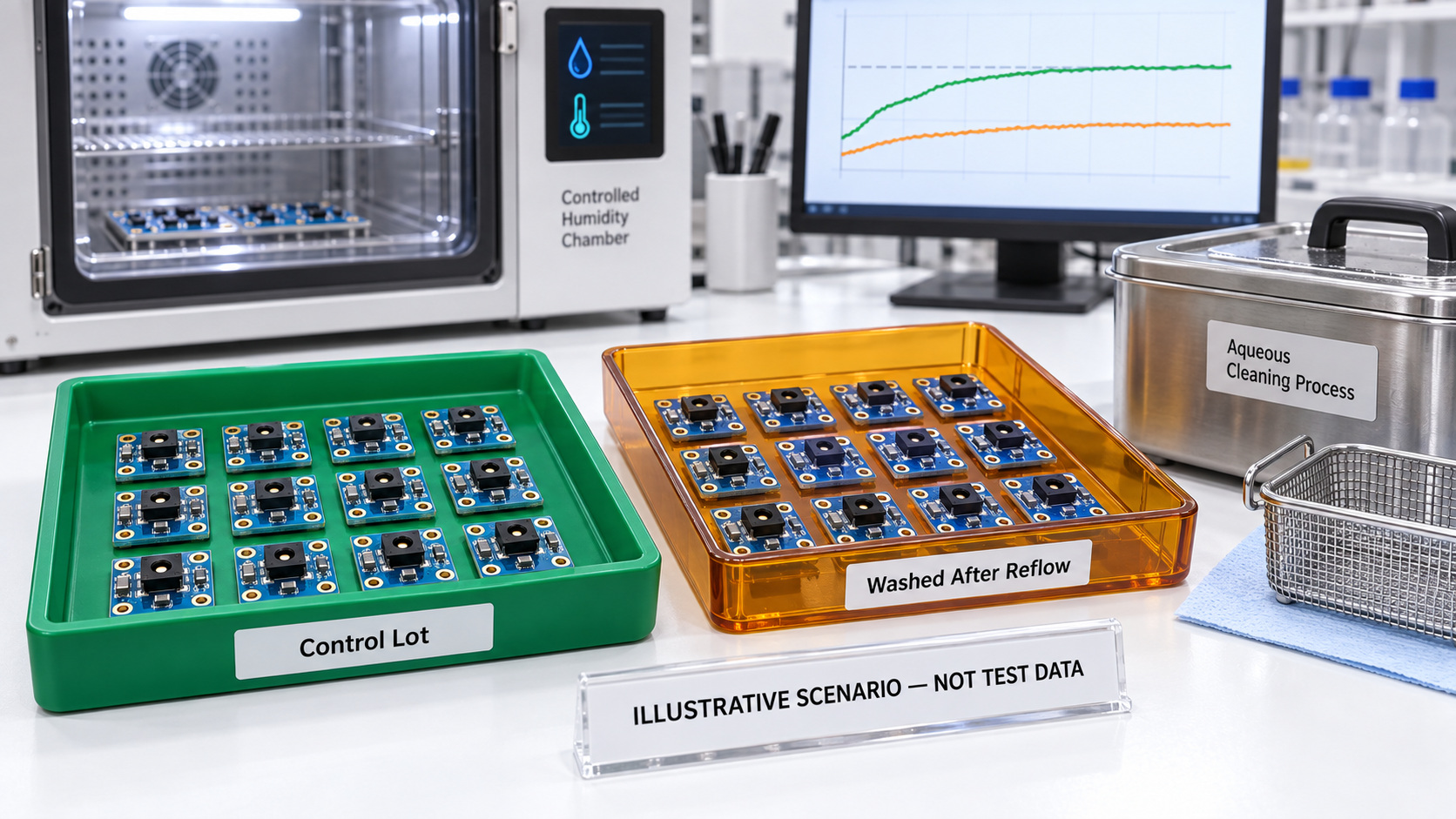
Illustrative production pattern: recovery versus a wash-linked offset
In this hypothetical example, one lot remains low at 72 hours while a control lot moves toward baseline. The affected boards alone had an aqueous wash after sensor mounting. That association makes the wash step a suspect, but differences in incoming lots, reflow profiles or fixture positions could also explain the result.
Preserve samples, verify the reference, and compare incoming records and matched measurement conditions before assigning a cause. Any deliberate exposure experiment belongs on designated engineering samples under an approved investigation plan. The illustration does not recommend washing sensors or establish a recovery deadline.
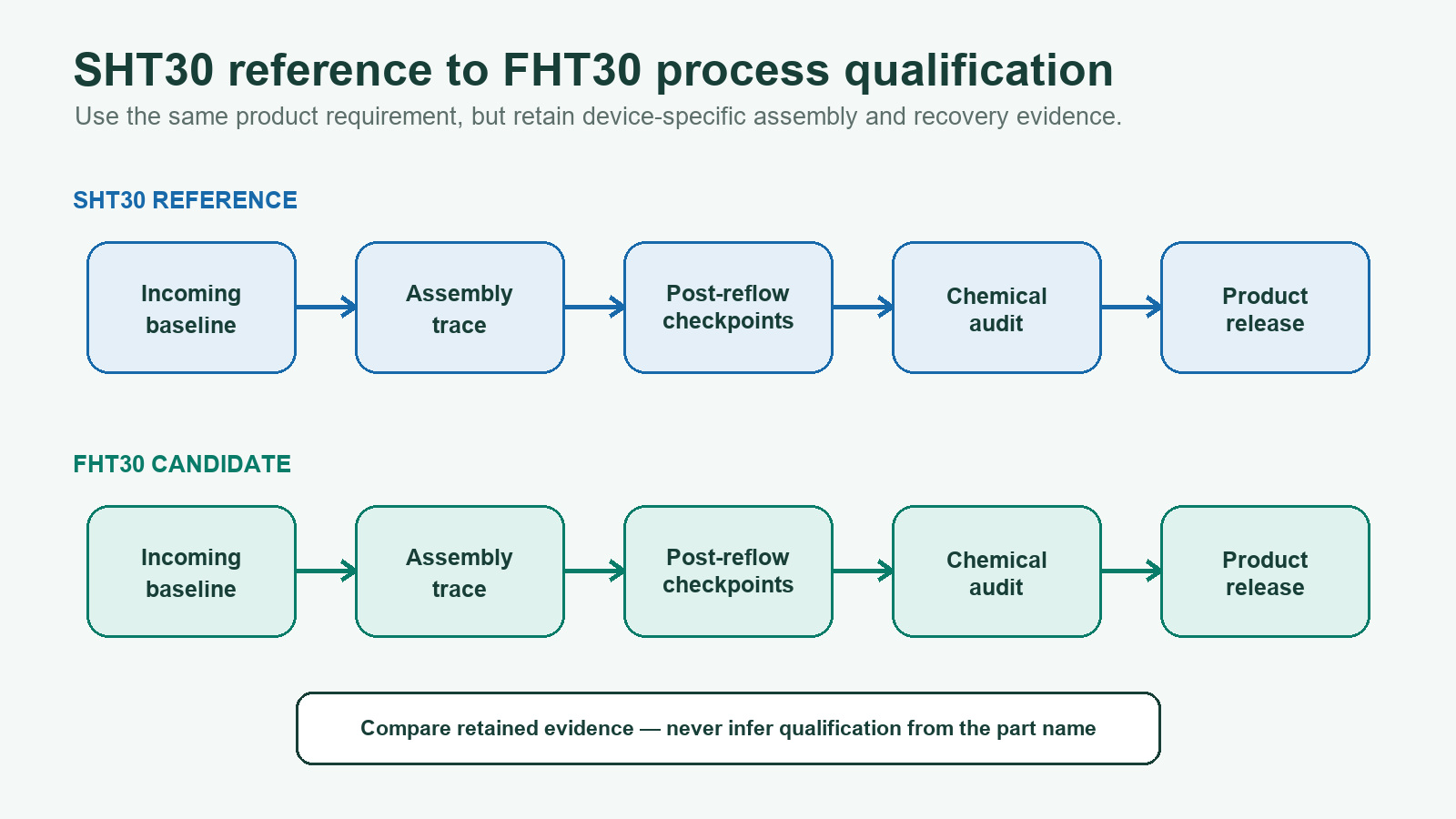
FROM SHT30 POST-REFLOW EVIDENCE TO FHT30 PROCESS QUALIFICATION
How should NYFEA FHT30 be qualified in the same production process?
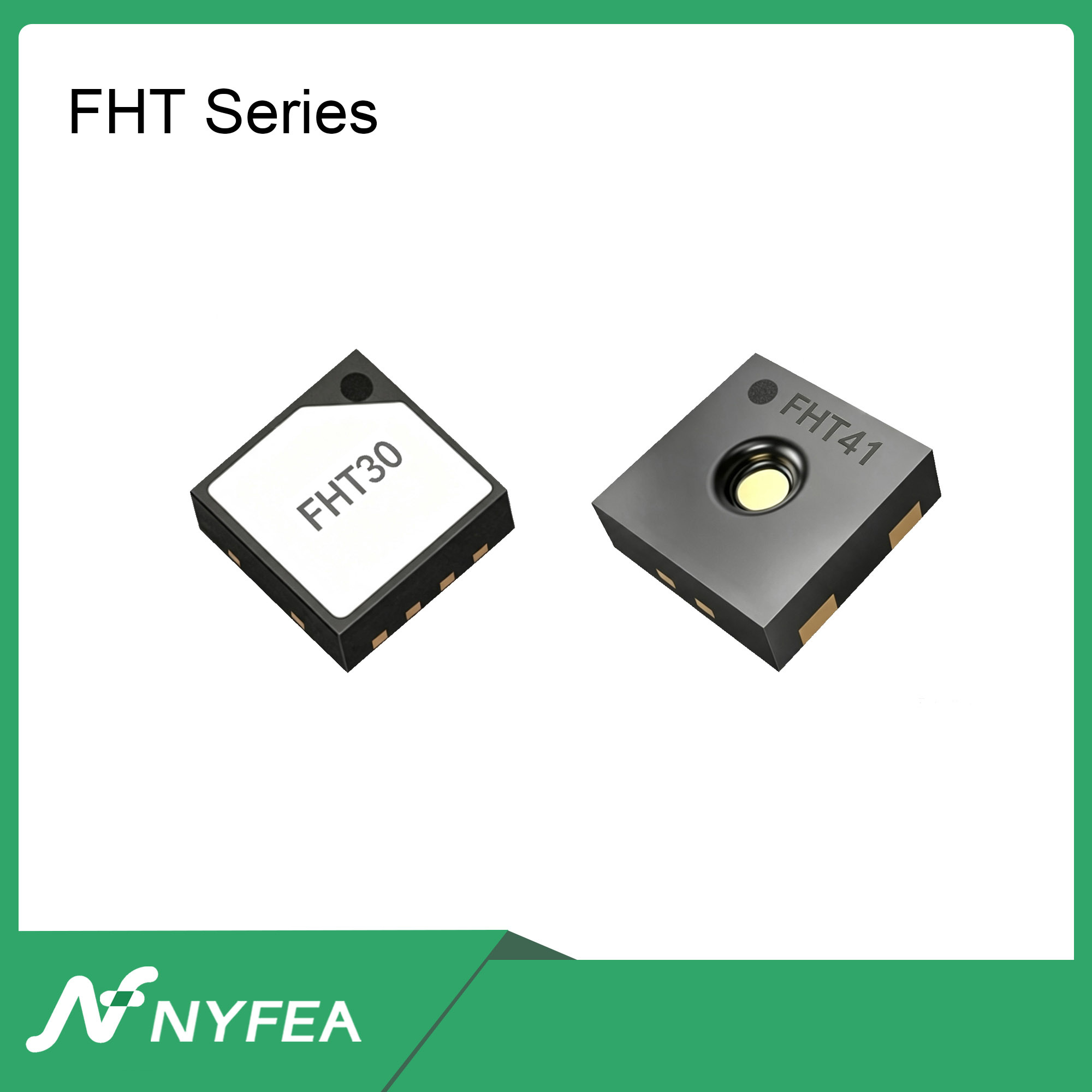
NYFEA FHT30 is a candidate for evaluation in SHT30-based designs. Once the process fault is understood, use the retained SHT30 baseline to define the FHT30 evaluation. Changing the sensor alone cannot establish that an uncontrolled wash, coating or thermal process is acceptable.
- Reuse the product requirement
- Keep the finished-product RH and temperature error budget, reference method and traceability requirements.
- Retain device-specific evidence
- Use the current FHT30 specification for package, assembly, chemical exposure and handling limits.
- Prove the production result
- Measure incoming baseline, post-reflow behavior, recovery trajectory, outliers and lot variation on the real process.
The FHT30 product page calls for protecting the sensing cavity from flux, wash fluid, dust, adhesive and coating. Use that guidance to plan the evaluation, and obtain the current assembly specification from NYFEA before defining its recovery and release limits. [3]
| Qualification block | SHT30 reference evidence | FHT30 candidate evidence |
|---|---|---|
| Incoming baseline | Lot identity and reference-controlled RH/T distribution | Its own lot identity and incoming distribution |
| Assembly | Profile, cycles, paste, flux and panel location | Approved FHT30 process and equivalent traceability |
| Post-reflow | Signed error and elapsed time at every checkpoint | Independent trajectory at the same planned checkpoints |
| Contamination | No-wash status, material and coating audit | Cavity-protection and chemical-exposure audit |
| Release | Finished-product limits across units and lots | Same product requirement under its qualified process |
A practical production release rule
Release a post-reflow humidity-sensor lot only when the reference is stable, communication and CRC are valid, signed RH and temperature errors meet finished-product limits at the defined release time, chemical exposure is controlled, and the result is repeated across the required samples, component lots and production runs.
If a lot passes only after an unrecorded wait, manual cleaning or software correction, the process is not controlled. Define the hold time, material restrictions and retest method before release.
Related production debugging: use the SHT30 high-humidity drift guide when the shift follows prolonged RH exposure, the ESP32 thermal-bias guide when the error follows board load, and the SHT30/FHT30 production-debugging guide when address, command or CRC behavior differs.
SHT30 reflow soldering and calibration FAQ
How do I know if an SHT30 humidity sensor is bad after reflow?
A low SHT30 reading immediately after reflow is insufficient to prove failure. Check reference stability, temperature difference, CRC and error versus time first. Persistent or worsening error needs process investigation; neither a low reading nor a 72-hour wait alone identifies permanent sensor damage.
How long does SHT30 need to recover after reflow soldering?
Sensirion describes typical SHTxx ambient recovery within one to three days. This is not a guaranteed SHT30 deadline. Define the hold time from the actual board, storage conditions, reference uncertainty, sample distribution and finished-product error budget.
Can the PCB be washed after the SHT30 is soldered?
Sensirion's SHTxx handling guidance says not to apply board wash and recommends no-clean solder paste. A board-wash requirement should be resolved in the assembly sequence with the sensor supplier before production; testing a washed sample does not override that handling restriction.
Should I calibrate SHT30 after reflow?
Not while the error is changing with time. Verify the reference, temperature difference, recovery trend and contamination history before considering a fixed correction.
Can the SHTxx recovery interval be applied directly to FHT30?
No. SHTxx handling instructions apply to Sensirion devices. FHT30 assembly, recovery and chemical-exposure limits require current NYFEA documentation and project evidence.
Is FHT30 a guaranteed drop-in replacement for SHT30 after reflow?
No universal drop-in claim is supported. The target PCB, firmware, assembly process, recovery behavior, measurement limits, enclosure and production lots all require validation.
Qualify FHT30 against your real SMT process
Send NYFEA your target RH/temperature error limits, reflow profile and cycle count, wash or coating history, and checkpoint CSV. These define a concrete FHT30 sample evaluation and the assembly guidance your project needs.
Sources and evidence
- Sensirion, Handling Instructions for SHTxx Humidity and Temperature Sensors, Version 9, June 2025. Section 2, pp. 5–8: post-reflow offset, assembly, board wash, coating and chemical exposure.
- Sensirion, SHT3x-DIS Datasheet, Version 7, December 2022. Table 1 footnote 7: contamination-related drift; sections 4.10–4.12: heater, status and CRC.
- NYFEA FHT30 engineering product page. Design and handling guidance; no FHT30 post-reflow measurements are supplied in this article.