SHT40 · SENSOR INTEGRATION
SHT40 Enclosure Design: Airflow, Protection and Response Time
An SHT40 may pass every I²C check and still respond slowly or measure the wrong air after enclosure assembly. Here is how to separate placement, airflow, PCB heat and protection effects before changing the sensor or adding an offset.
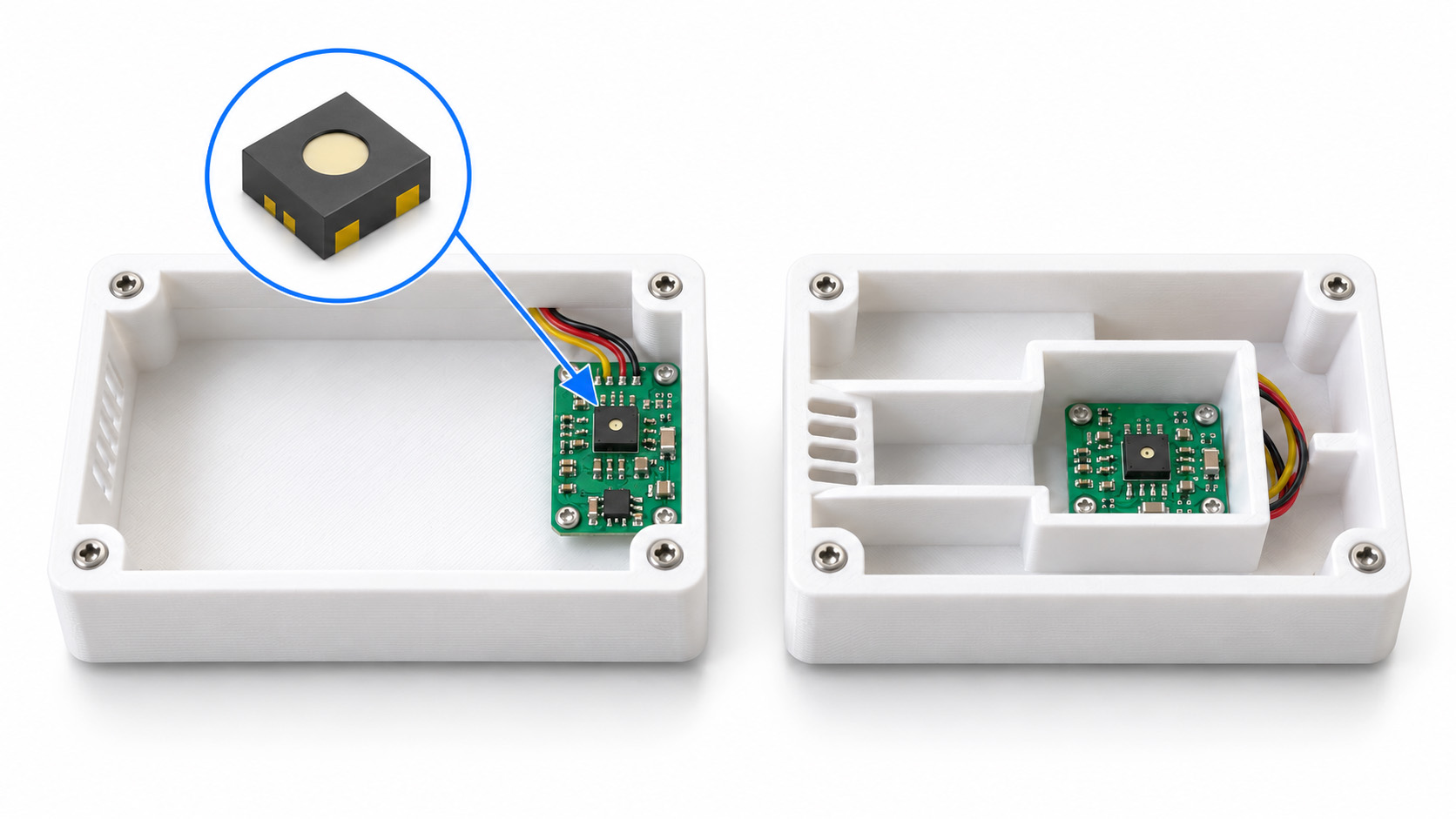
The direct answer
When an SHT40 reads slowly or reports a value that changes after you close the housing, check whether the sensor is actually sampling the air you intend to measure. Trace the path from the external opening to the sensing aperture on top of the device. Look for a large stagnant cavity, a vent that bypasses the sensor, and a warm PCB behind it. Then assess splash protection and compare the bare sensor, mounted PCB and complete enclosure under the same conditions. A fixed software offset should come after this diagnosis, not before it: enclosure errors can change with airflow, board power and ambient temperature.
Sensirion specifies 4 s humidity response time (τ63) for the SHT40 at 25 °C and 1 m/s airflow. τ63 is the time to reach 63% of a humidity step. It is a sensor test condition, not a promise for the assembled product. The SHT4x datasheet explicitly makes application response dependent on the design-in.
SHT4x is a digital sensor platform for measuring relative humidity and temperature at different accuracy classes. Its I2C interface provides several preconfigured I2C addresses while maintaining an ultra-low power budget (0.4 μW). The power-trimmed internal heater can be used at three heating levels thus enabling sensor operation in demanding environments.
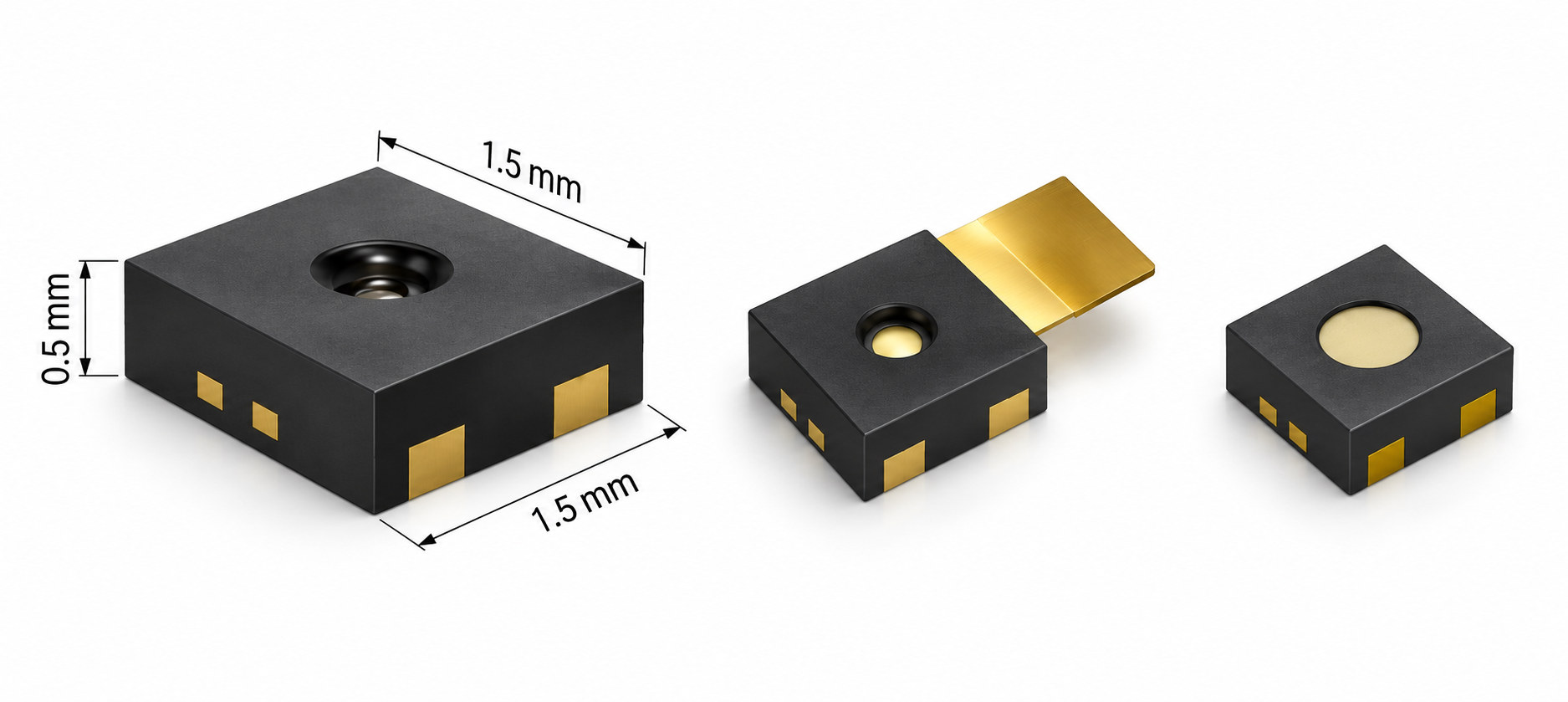
Put the SHT40 where the target air actually is
The SHT40 senses the microclimate at its opening. If your product claims to report room air, a sensor inside a warm electronics compartment can give a repeatable but unrepresentative result. If the target is duct air, putting the enclosure beside the duct is a placement problem before it is a sensor-selection problem. Define the target air volume and its expected airflow before deciding where the SHT40 board and enclosure vents belong.
Give the air a short, useful route
Vent area alone is not the design variable. The useful combination is vent position, air path and dead volume around the SHT40. A large cavity with a small opening exchanges slowly; an opening aimed at a solid wall may miss the sensor altogether. A compact sensing compartment with openings that let target air reach the device is a better starting prototype. Sensirion's humidity and temperature design guide illustrates these path and dead-volume effects.
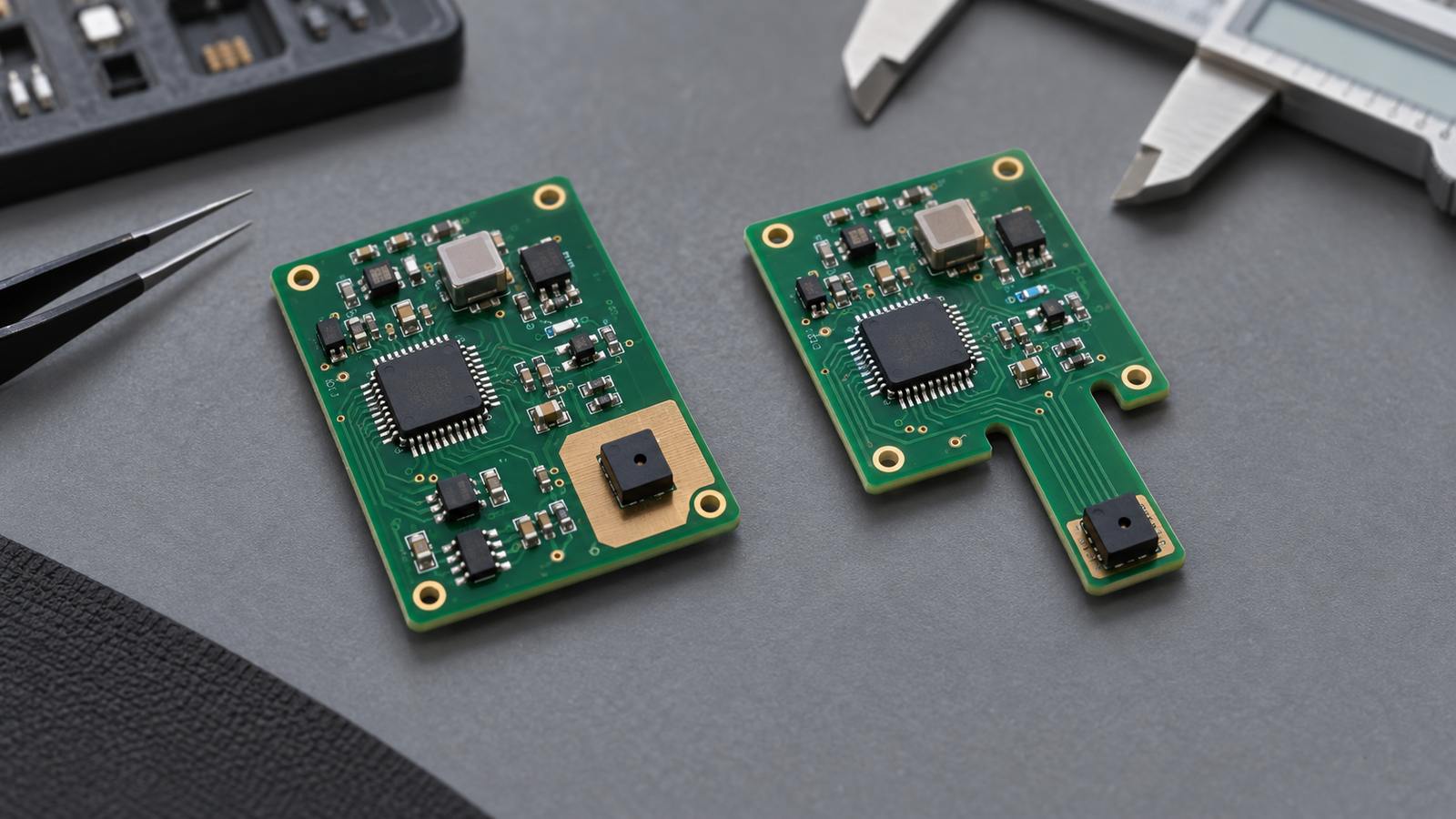
Separate the sensor from PCB heat
Relative humidity changes with temperature. A warm SHT40 can pass every digital integrity check while still reporting conditions local to the PCB rather than the target air. Compare the sensor temperature with a nearby reference when the MCU, display, radio and power supply switch on. Review copper, ground planes and the mounting bridge between heat sources and the sensing area. A board-edge position or a narrow sensing section may help, but its mechanical strength and manufacturing process still need review. The SHT4x datasheet also advises against soldering the central die pad or adding copper underneath the device, because those changes alter its thermal behavior.
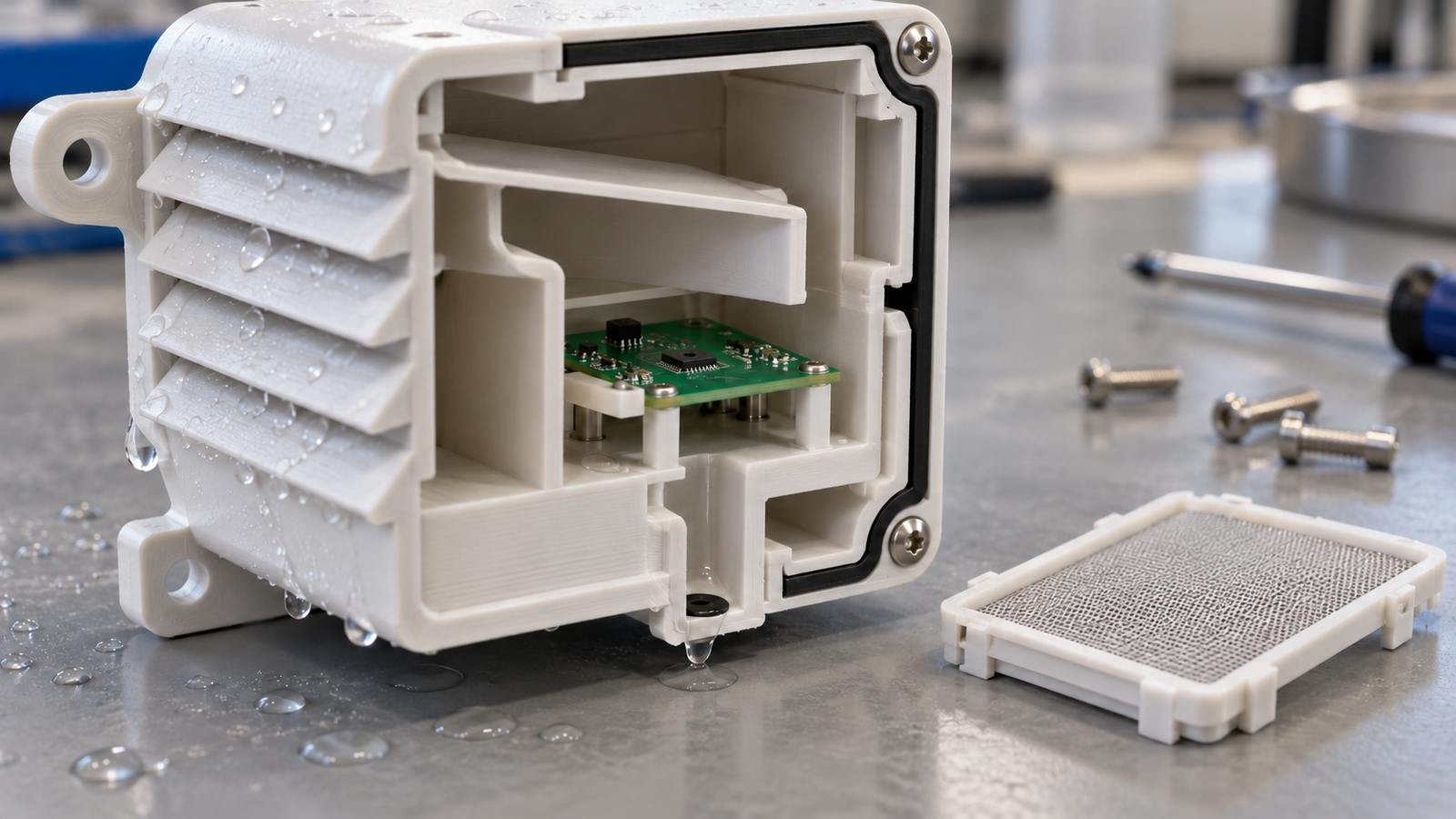
Protect against water without sealing away the measurement
Outdoor or greenhouse designs must manage droplets, dust and contamination while still allowing water vapor to reach the sensor. Review the vent orientation, baffle, drainage path and any vapor-permeable protection as one assembly. Avoid creating a water trap or a new stagnant chamber immediately in front of the SHT40.
The exact SHT40 order code matters. SHT40-AD1B-R3 is the base device; SHT40-AD1F-R2 has an integrated polyimide membrane; SHT40-AD1P-R2 includes a removable protective cover for processing. The cover is removed before operation; it is not an operating vent membrane. Check the datasheet's protection and ordering sections before applying an enclosure design to a different variant.
Compare three builds instead of guessing
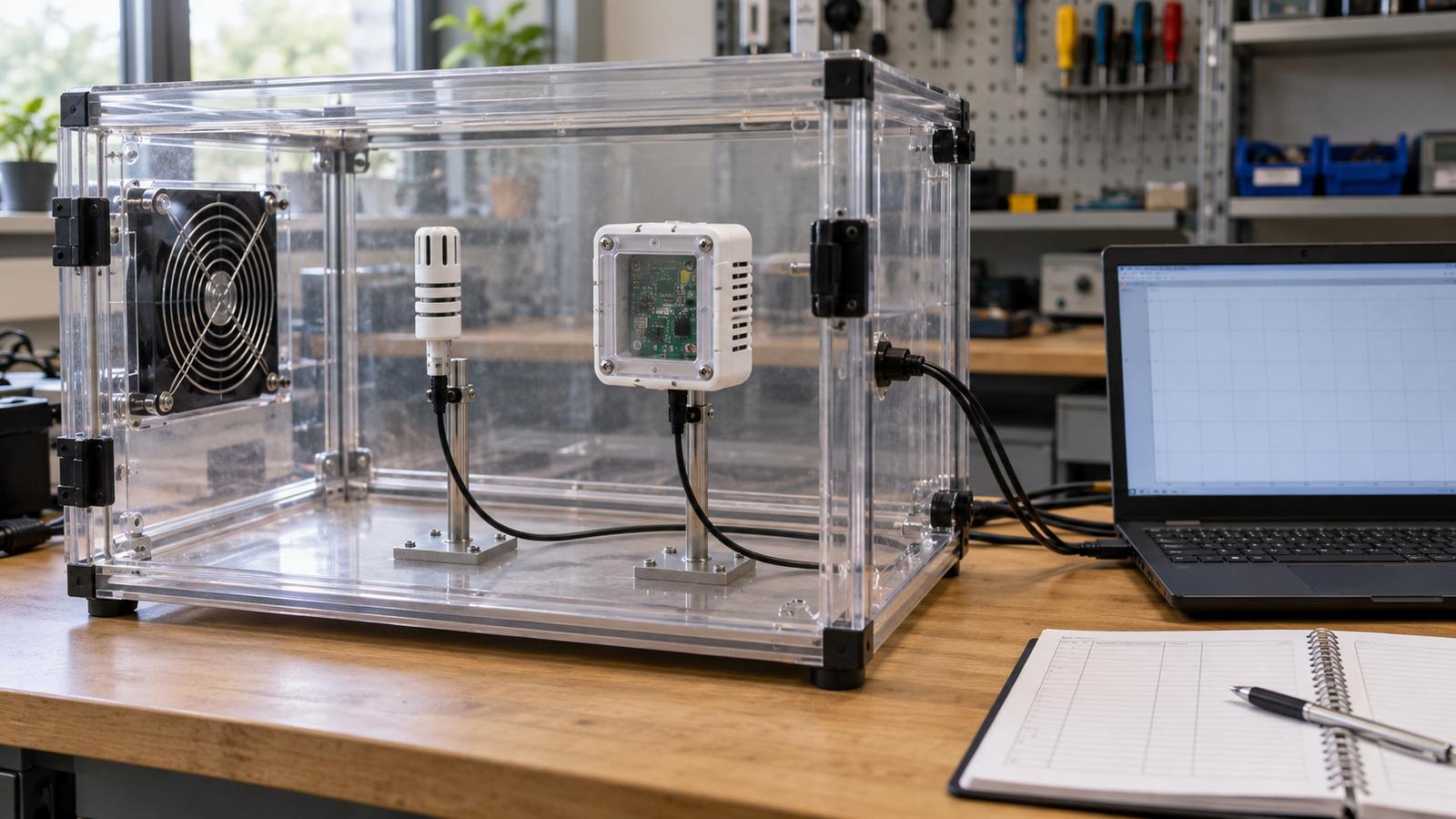
Log the same SHT40 bare, mounted on the product PCB, and inside the complete housing. Keep the reference probe near the intended measurement location. For each build, record timestamps, temperature, relative humidity, airflow or fan state and a repeatable environmental change. Compare steady-state differences and the time to reach the same fraction of the change. If the environmental step is poorly controlled, report the observed trend rather than inventing a τ63 figure.
| Observation | Most useful first check | Decision |
|---|---|---|
| Bare sensor is already inconsistent | Exact part, supply, I²C transaction, reference | Fix the measurement chain |
| PCB mounting raises temperature and lowers RH | Heat sources, copper and placement | Redesign the thermal path |
| Only the housing slows the response | Vents, dead volume, baffle, barrier | Redesign the air path |
| Errors follow spray or condensation | Droplets, drainage, contamination | Redesign protection and recovery |
Check the electrical path before blaming the housing
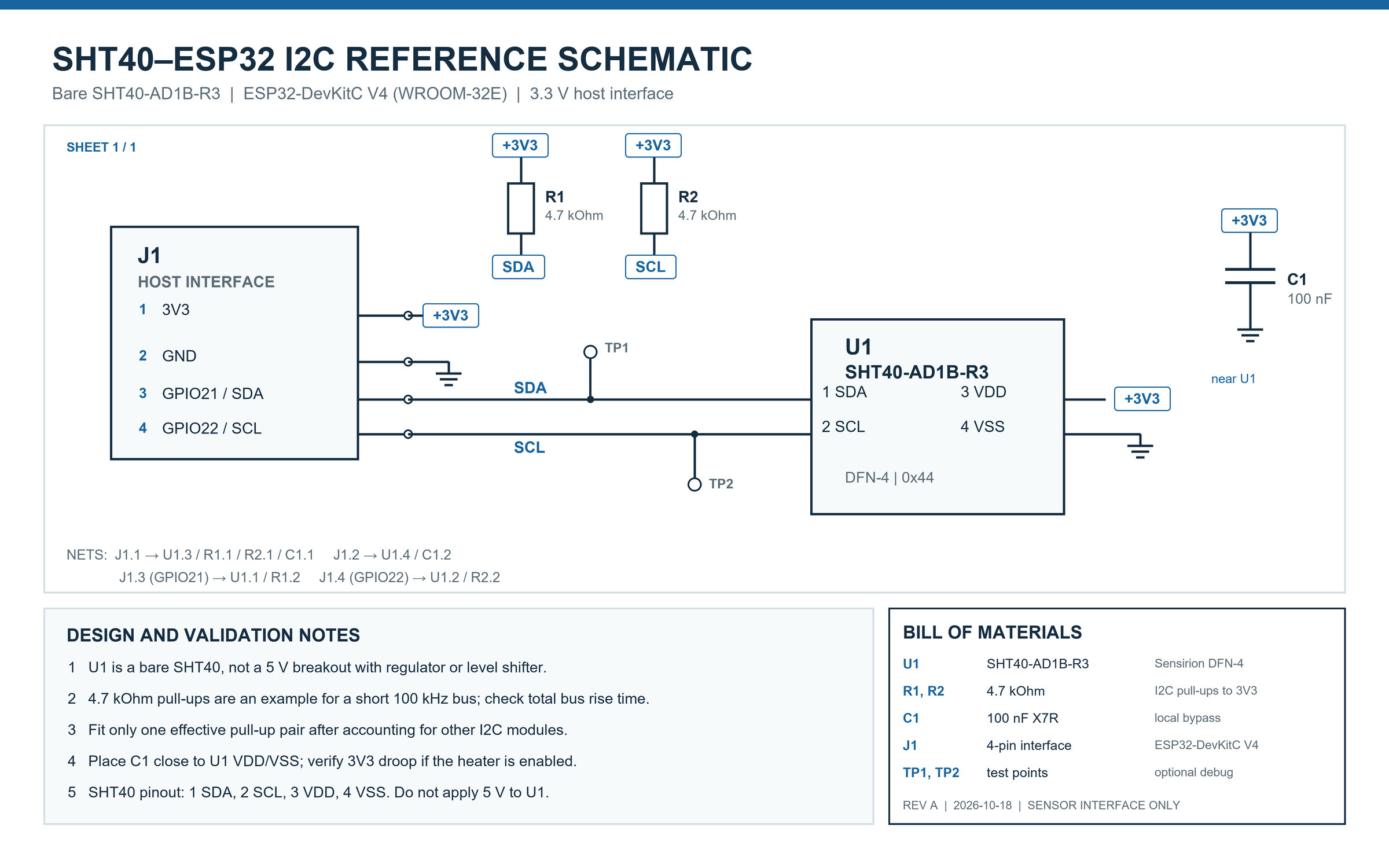
Intermittent detection or CRC failures call for an electrical check first. The following drawing is a short, local 3.3 V reference interface between an ESP32-DevKitC V4 and a bare SHT40-AD1B-R3. It shows GPIO21/SDA, GPIO22/SCL, one effective pair of pull-ups and local decoupling. A third-party breakout may already include pull-ups, regulation or level shifting; verify its schematic before copying values. SHT4x pin assignment.
From an SHT40 prototype to a qualified assembly
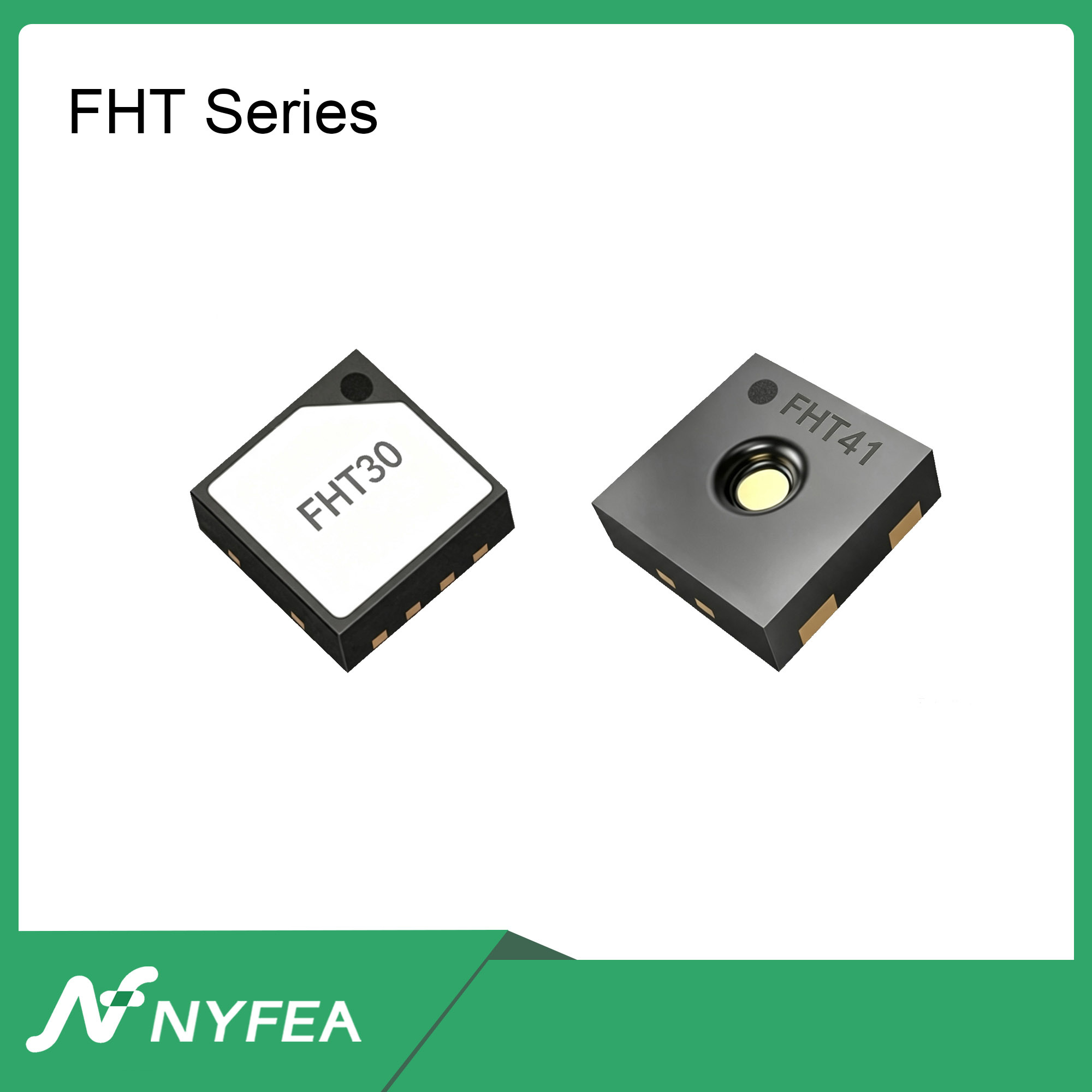
When a new design needs a second sensor candidate, NYFEA FHT40 can enter the evaluation. Compare the exact order codes, electrical and mechanical requirements, firmware behavior and finished-enclosure response. No package, command or production interchangeability is implied by the model names alone.
Review NYFEA FHT40Discuss the applicationSHT40 enclosure FAQ
Why is an enclosed SHT40 slower than the 4 s datasheet value?
The 4 s figure is the device's humidity τ63 at 25 °C and 1 m/s. The PCB, air path and enclosure change the assembled response.
Will a larger vent always fix a slow SHT40?
No. Air can still bypass the sensor, while heat from the PCB can dominate the reading. Compare bare, mounted and enclosed configurations before changing the vent.
Is an SHT40 waterproof?
Do not infer an assembly rating from the chip name or an illustration. SHT40 order codes have different protection options, and the finished housing requires its own validation.
When should I choose another sensor?
First establish that placement, air exchange, heat coupling and protection have been tested against the product requirement. Then compare exact orderable variants and their operating limits.
Technical sources
- Sensirion, SHT4x Datasheet V7.3: response-time conditions, variants, pinout and package guidance.
- Sensirion, Design Guide for Humidity and Temperature Sensors V2: location, dead volume, thermal coupling and assembled response.
SHT40 and SHT4x identify Sensirion products. NYFEA FHT40 is an independent product; NYFEA is not affiliated with or endorsed by Sensirion. The photo-style concepts on this page illustrate design choices rather than recorded test results.