SHT30 SENSOR GUIDE
SHT30 Sensor Guide: Pinout, I²C Address, Accuracy and Module Types
SHT3x-DIS is the next generation of Sensirion’s temperature and humidity sensors. It builds on a new CMOSens® sensor chip that is at the heart of Sensirion’s new humidity and temperature platform. The SHT3x-DIS has increased intelligence, reliability and improved accuracy specifications compared to its predecessor.
What is an SHT30 sensor?
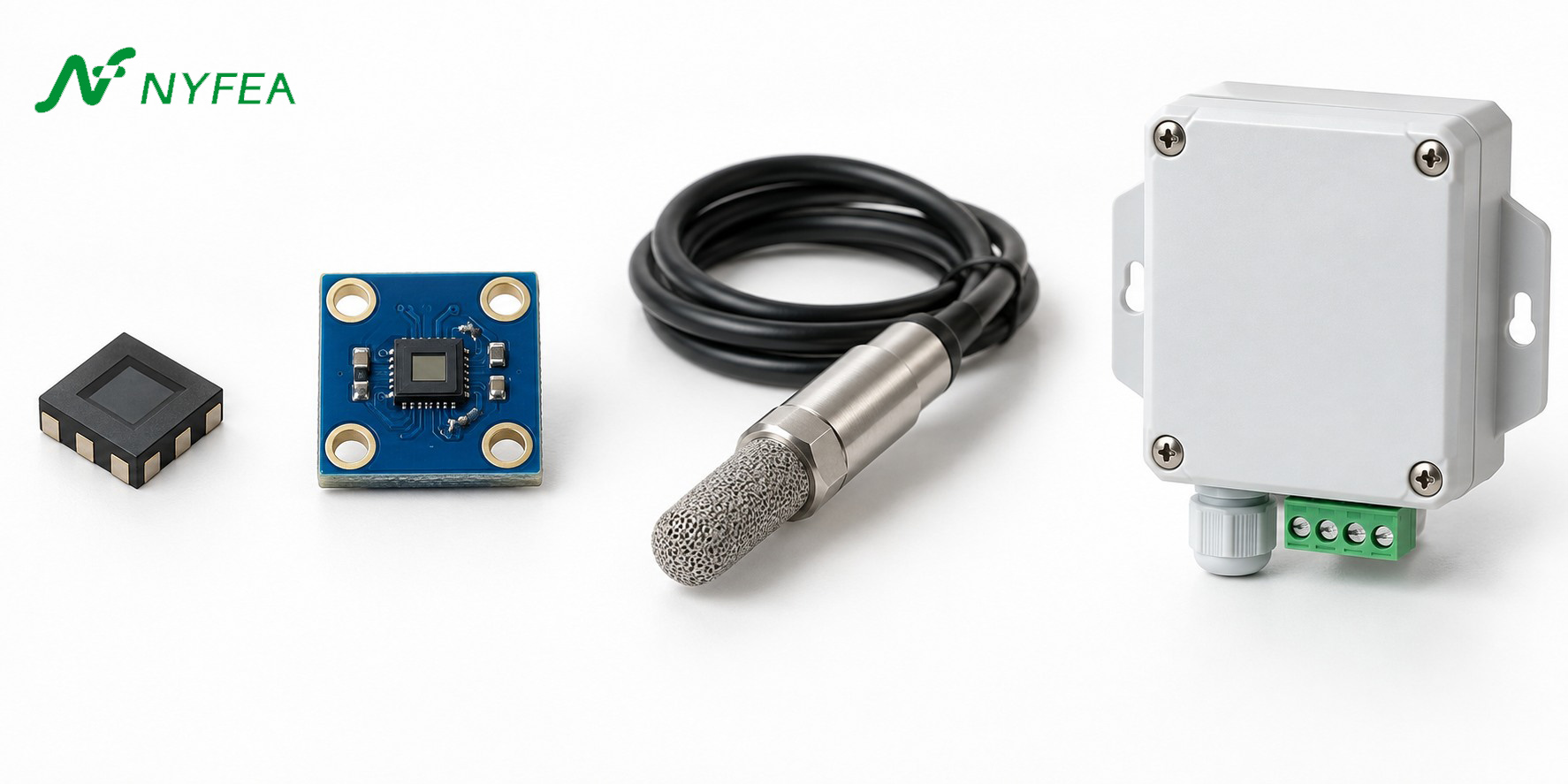
SHT30 is a Sensirion temperature and relative-humidity sensor in the SHT3x family. The SHT30-DIS is a factory-calibrated digital I²C device. Its selectable 7-bit addresses are 0x44 and 0x45. The SHT30-ARP is an analog-output variant, while a probe or RS485 transmitter adds its own electronics around a sensor. The host must use the interface of the complete item, not an interface inferred from the word “SHT30.”
SHT30-DIS quick specifications
The figures below apply to the SHT30-DIS digital IC, not automatically to every module, cable assembly or transmitter bearing “SHT30” in its name. Typical accuracy is not a worst-case system guarantee.Its functionality includes enhanced signal processing, two distinctive and user selectable I2C addresses and communication speeds of up to 1 MHz.SHT30 can mean a bare digital IC, an analog variant, a breakout board, a cabled probe or a complete industrial transmitter. Identify the exact part and its external interface before choosing wiring or code.
| Parameter | SHT30-DIS value | Design meaning |
|---|---|---|
| Interface | I²C, up to 1 MHz | Check host timing and complete bus conditions. |
| 7-bit address | 0x44 default; 0x45 alternate | ADDR low selects 0x44; high selects 0x45. |
| Supply | 2.15–5.5 V | The breakout board may impose its own limits. |
| Typical RH accuracy | ±2 %RH | Consult the tolerance curves across humidity and temperature. |
| Typical temperature accuracy | ±0.2 °C at 0–65 °C | Does not include PCB or enclosure heating. |
| Specified ranges | 0–100 %RH; −40 to 125 °C | Accuracy changes across the range. |
| Package and data | 2.5 × 2.5 × 0.9 mm DFN-8; CRC-8 after each 16-bit data word | Use the exact package drawing and verify both checksums. |
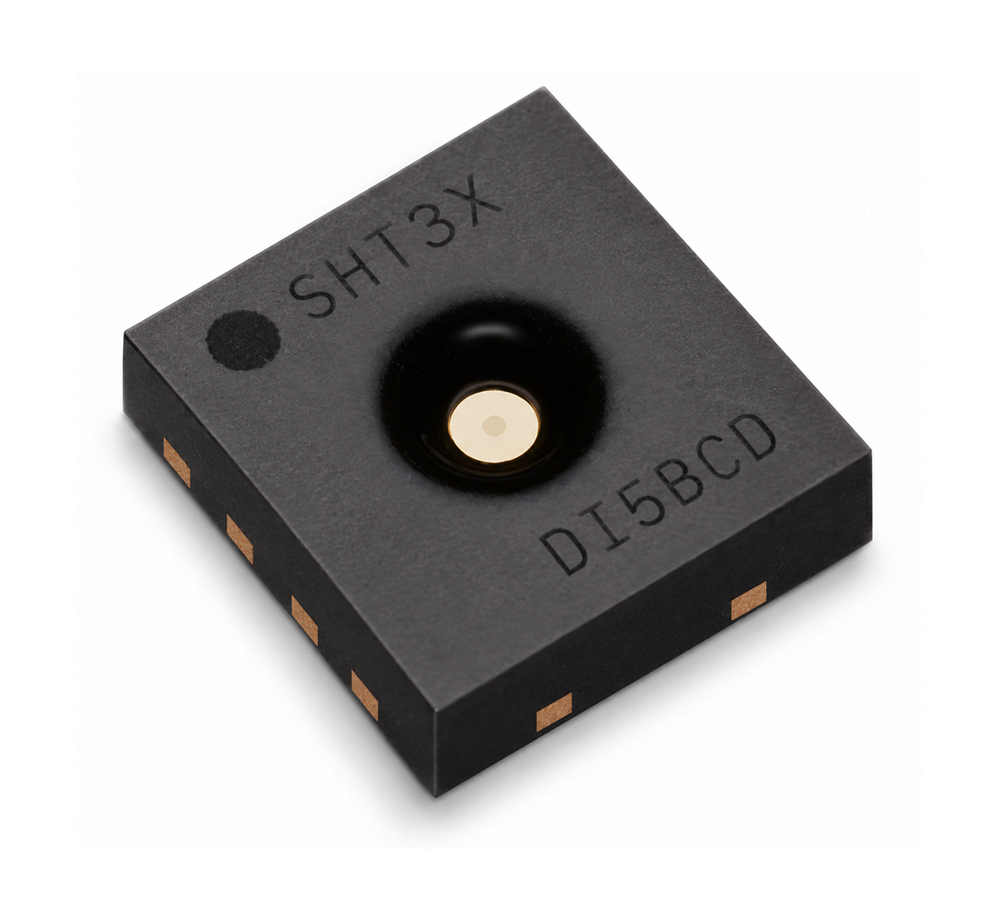
SHT30-DIS-BThe SHT3x humidity sensor series consists of a low-cost version with the SHT30 humidity sensor, a standard version with the SHT31 humidity sensor, and a high-end version with the SHT35 humidity sensor |
Serial Clock and Serial Data (SCL, SDA)SCL is used to synchronize the communication between microcontroller and the sensor. The clock frequency can be freely chosen between 0 to 1000 kHz. Commands with clock stretching according to I2C Standard11 are supported.). |
Why do SHT30 modules have different pins and protocols?
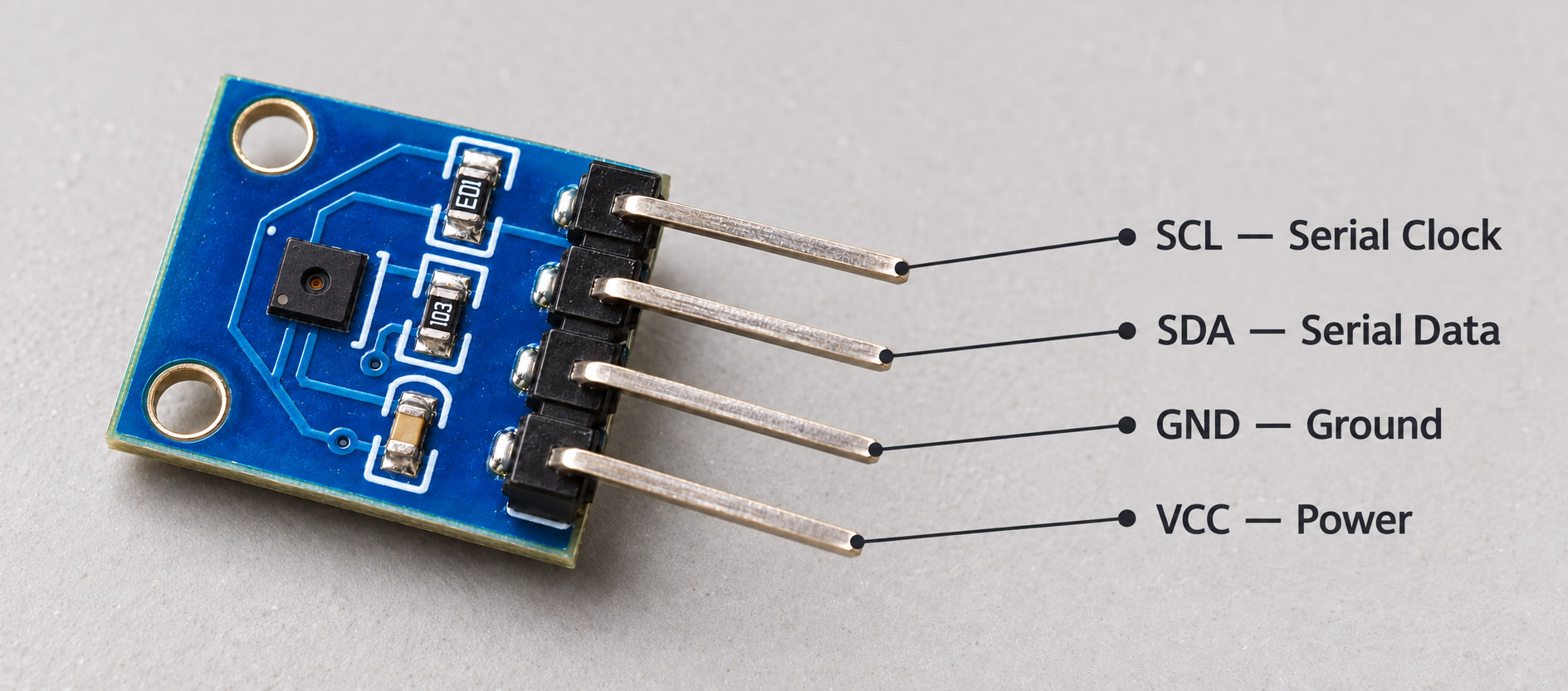
“SHT30 sensor” is used for both a component and products built around it. The external connector belongs to the module or instrument maker. The following comparison prevents a common error: applying an I²C example to analog outputs or an RS485 transmitter.
| What you have | Typical external clues | What the host reads | Check before connection |
|---|---|---|---|
| SHT30-DIS bare IC | DFN-8; SDA, SCL, ADDR, ALERT and nRESET in the datasheet | I²C | Exact order code, PCB footprint and 2.15–5.5 V supply. [3] |
| Digital breakout | Often VCC, GND, SDA and SCL | I²C through the board | Regulator, level shifting, pull-ups and address strap in that board's documentation. |
| SHT30-ARP or analog module | Analog temperature/RH outputs, often marked T and RH | ADC voltage | Transfer function and supply of the exact analog IC or board. |
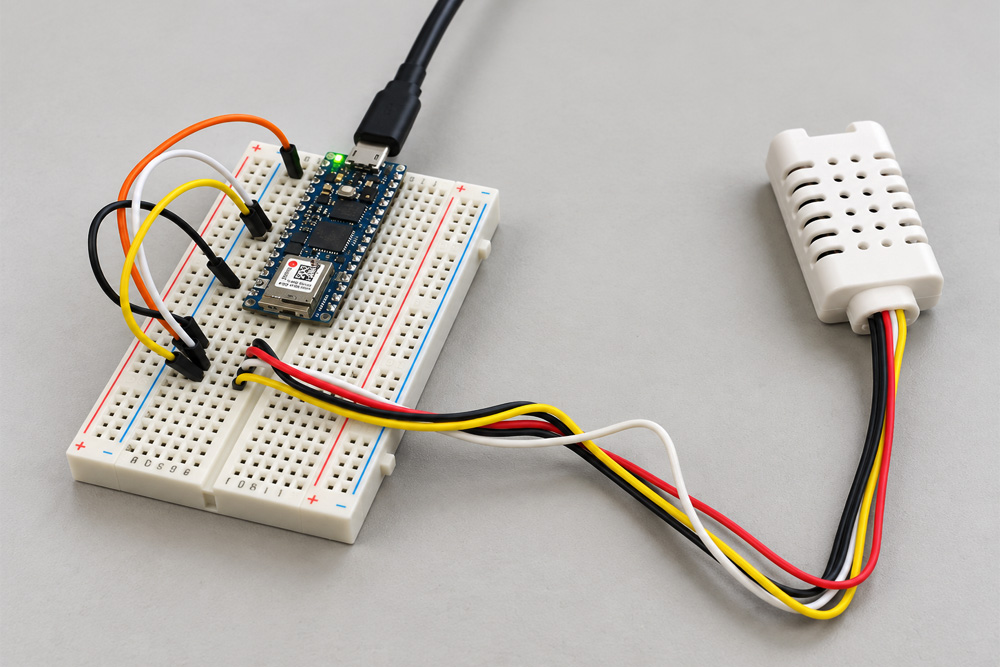
| Cabled protective probe | Ventilated tip and cable; one four-wire example uses I²C | Probe-specific interface | Wire colors, fixed address, pull-ups and ingress claims for that model. [5] |
| RS485/Modbus transmitter | Industrial enclosure and A/B communication terminals | Modbus RTU over RS485 | Supply, register map, baud rate and address in the transmitter manual. The internal SHT30 IC is not itself an RS485 device. [6] |
“Waterproof” in a listing is not a universal immersion rating. A humidity probe must admit air at its sensing opening; verify the exact enclosure rating and use conditions.
Where does the SHT30 sit in the system?
The bare IC is only the sensing layer. A breakout adds a PCB and connector. A protective probe adds a cable and housing. An RS485 transmitter also adds conversion electronics and a controller-facing protocol.
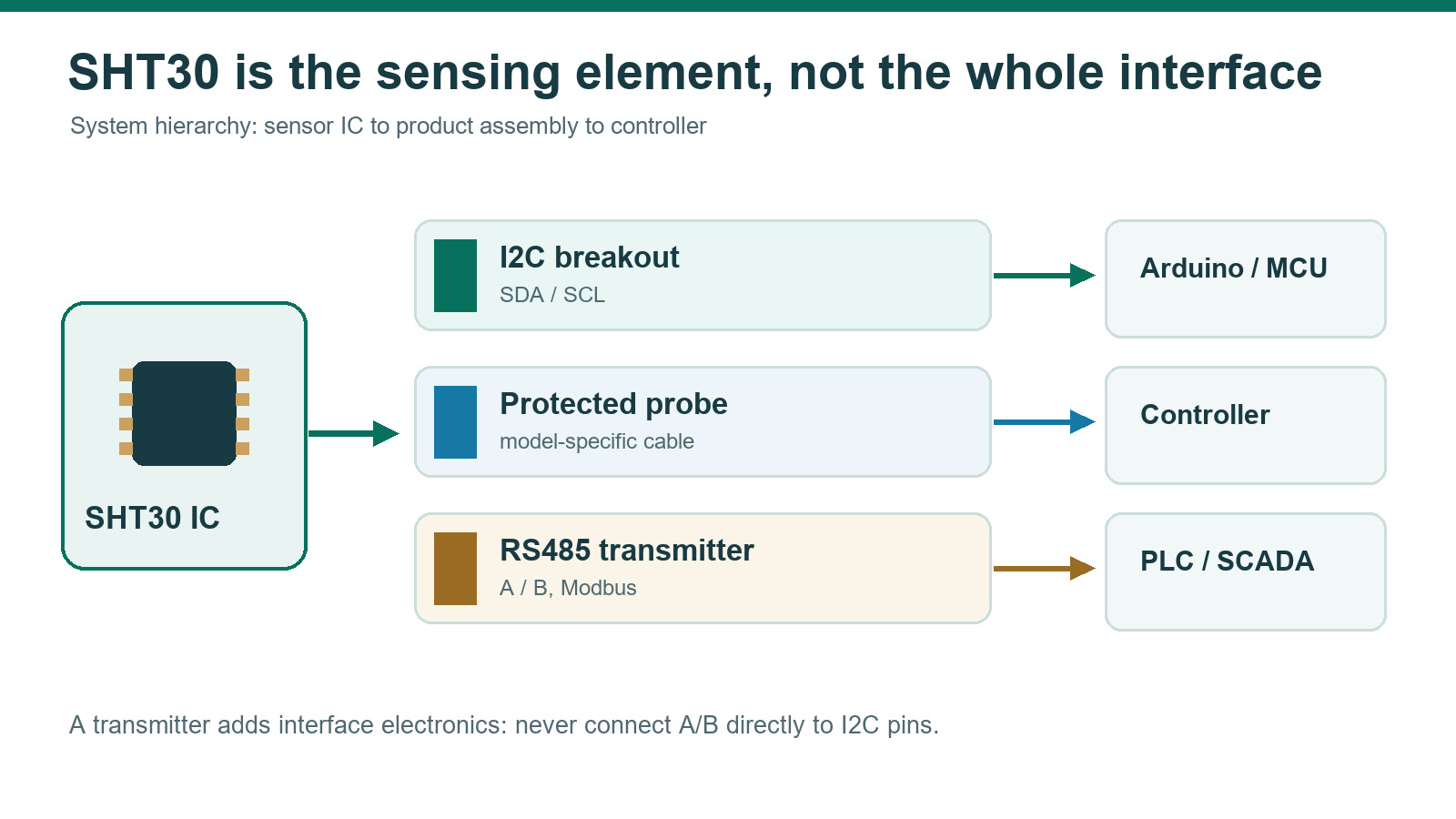
This explains why an SHT30-based RS485 product is not addressable at 0x44 from a PLC: that address exists on the internal I²C side, while the external A/B pair belongs to the transmitter.
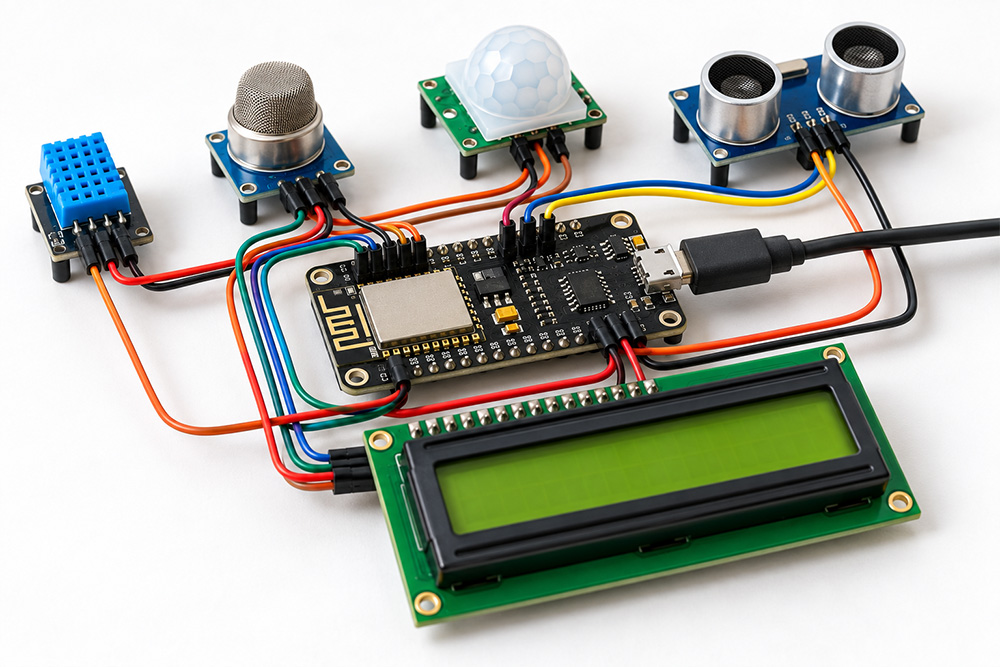
How can you identify the SHT30 interface before wiring?
Read the complete product's part number and terminal labels. The visible connector decides which host peripheral to use; wire color alone is not a standard.
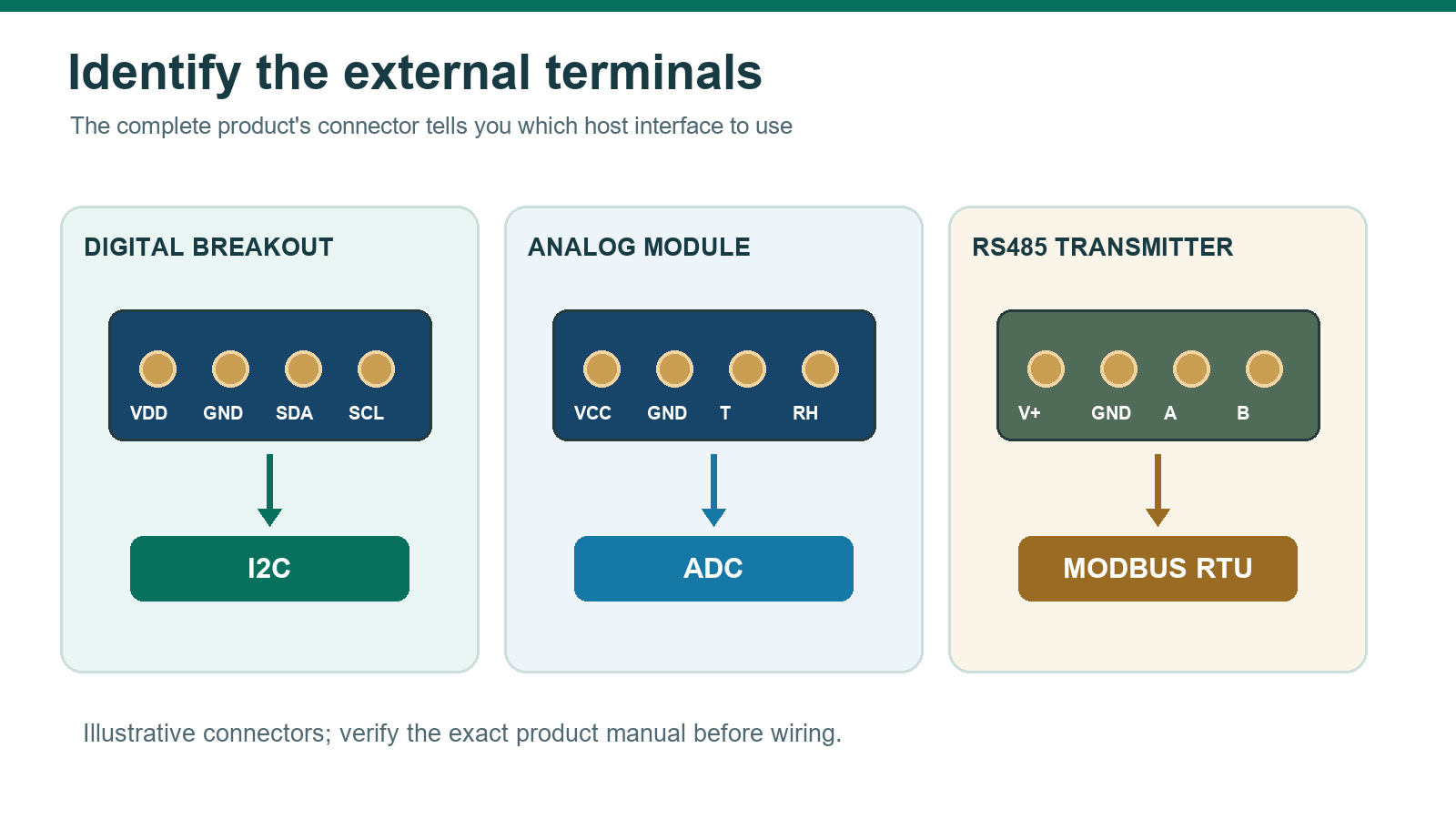
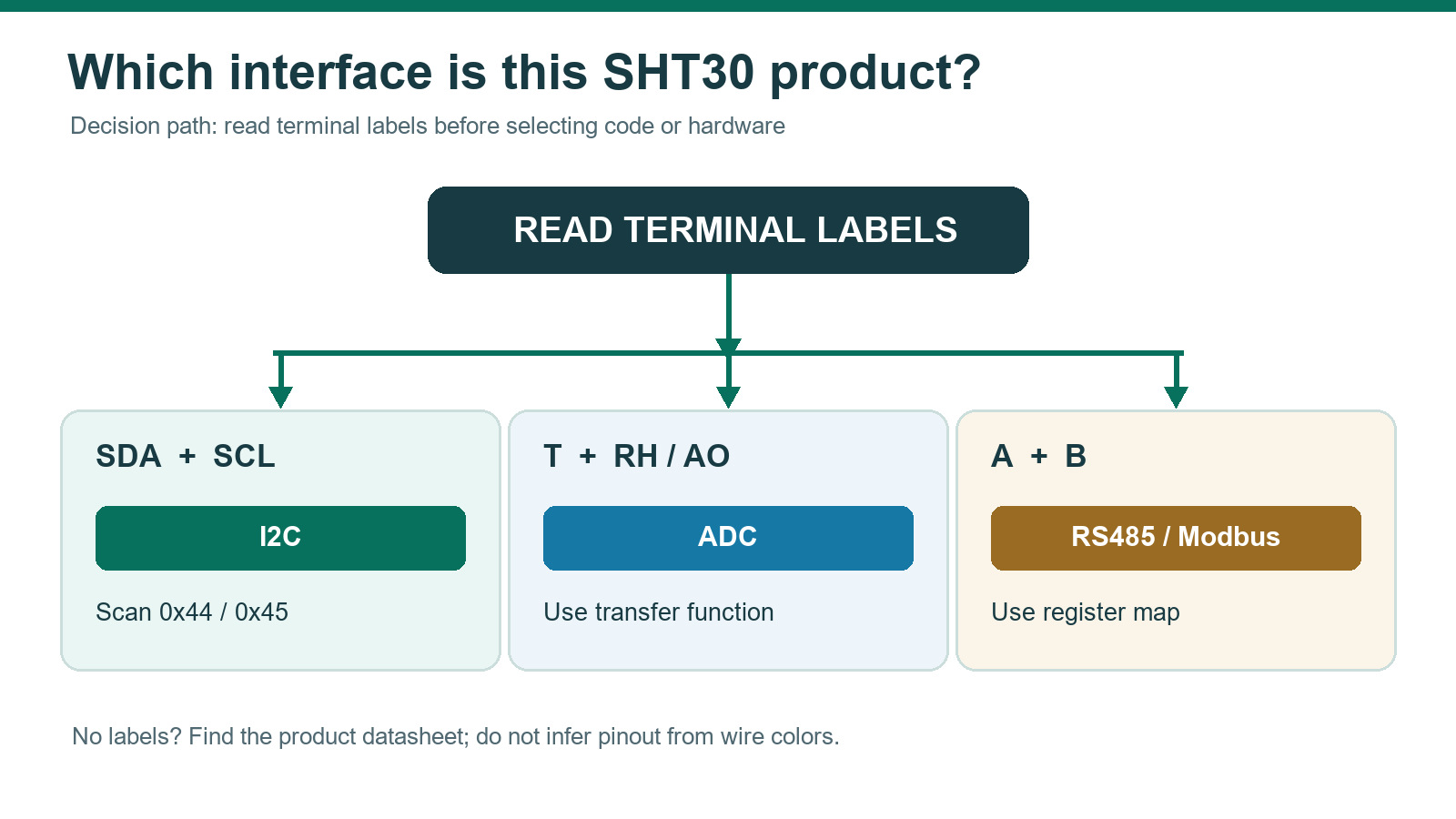
Use the terminal labels as the first branch. SDA/SCL implies an I²C host. T/RH or AO points to analog outputs and an ADC. A/B points to a differential serial interface that requires a transmitter-specific protocol manual. Confirm the supply pins separately; never infer them from wire colors.
| Terminal clue | First document to open | First host check |
|---|---|---|
| SDA / SCL | I²C module wiring diagram | Scan 0x44/0x45; confirm pull-ups and logic voltage. |
| T / RH / AO | Analog transfer-function sheet | Measure the output voltage with an ADC. |
| A / B, D+ / D− | Transmitter Modbus manual | Use an RS485 transceiver and the documented register map. |
If the board has four unlabeled wires, stop at the product datasheet. Even an established probe vendor warns that wire colors may vary between batches.
What is the SHT30-DIS pinout?
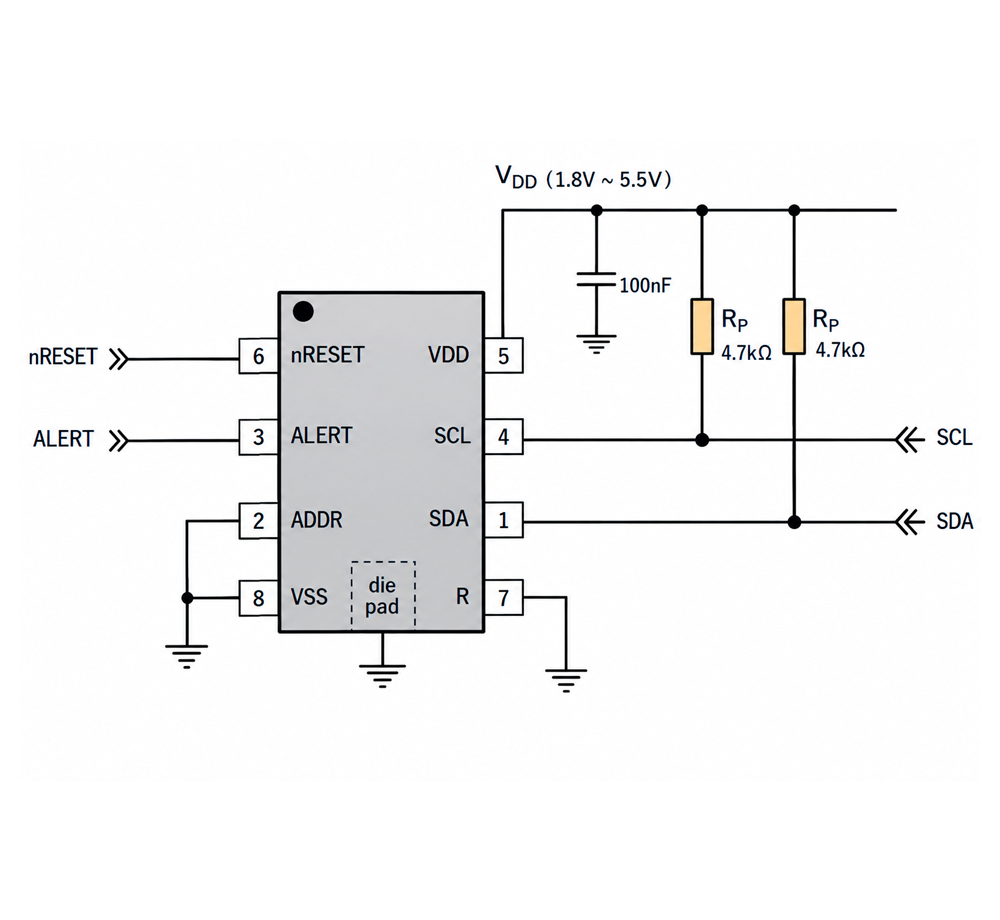
The SHT30-DIS is an eight-pin DFN component. The drawing below shows the manufacturer's transparent top view: pins 1–4 descend on the left; pins 8–5 descend on the right. A breakout's four connector pins are a different pinout.
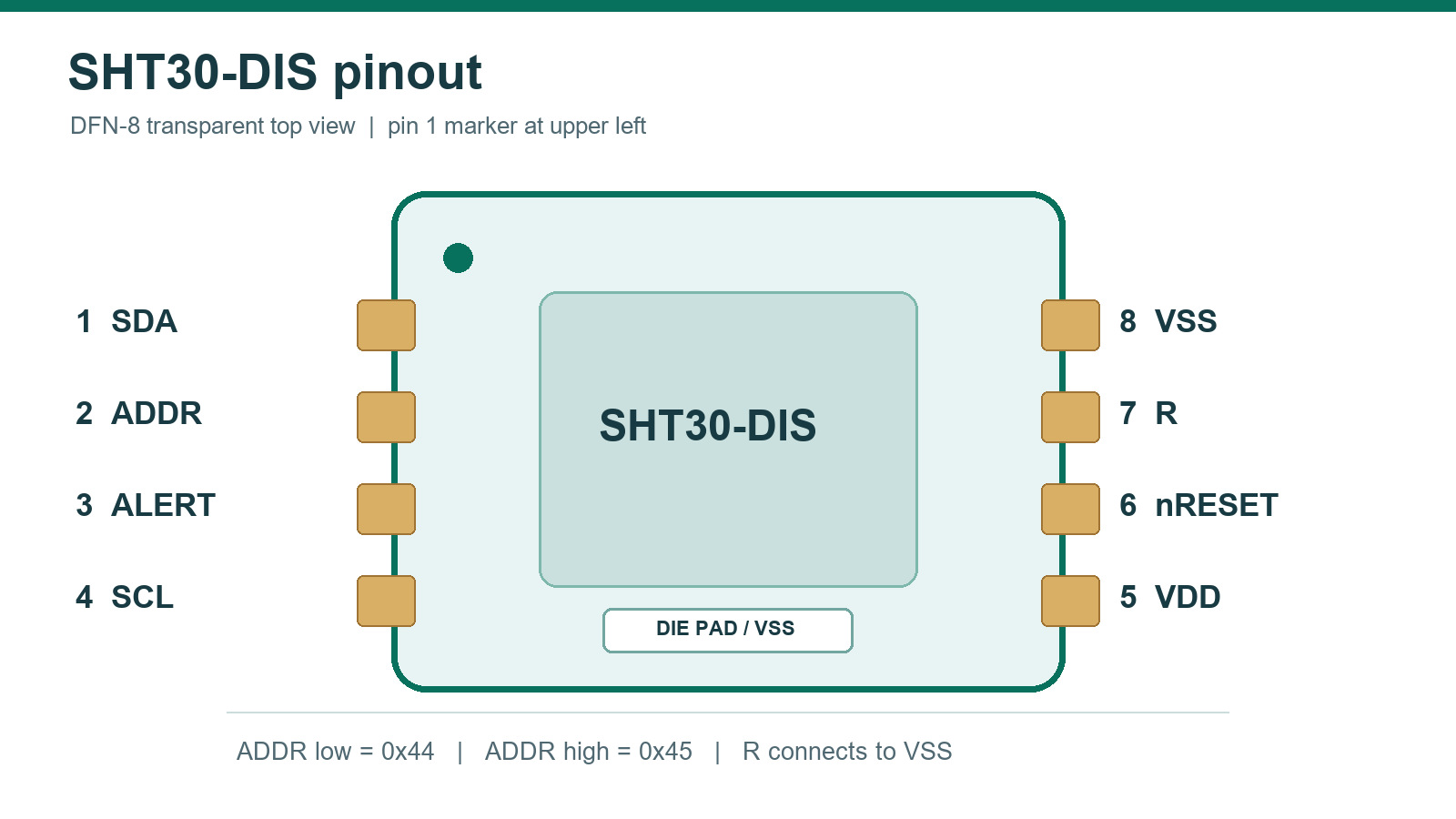
Pin 2, ADDR, must be tied high or low; do not leave it floating. Pin 7, R, has no signal function but connects to VSS. The center die pad is internally connected to VSS. Place a 100 nF capacitor close to VDD and VSS, as the datasheet recommends.
| Pin | Name | Function |
|---|---|---|
| 1 | SDA | I²C data |
| 2 | ADDR | Address selection; tie high or low, never float |
| 3 | ALERT | Alarm output; leave floating when unused |
| 4 | SCL | I²C clock |
| 5 | VDD | Supply; place 100 nF decoupling nearby |
| 6 | nRESET | Active-low reset; follow datasheet if unused |
| 7 | R | No electrical function; connect to VSS |
| 8 | VSS | Ground |
What is the SHT30 I²C address: 0x44 or 0x45?
SHT30-DIS uses the 7-bit address 0x44 when ADDR is low and 0x45 when ADDR is high. ADDR cannot float. Some breakout or probe designs fix the selection in hardware, so inspect the exact board before expecting both options. Sensirion specifies the address at the IC level; Adafruit's cabled probe is an example fixed at 0x44.
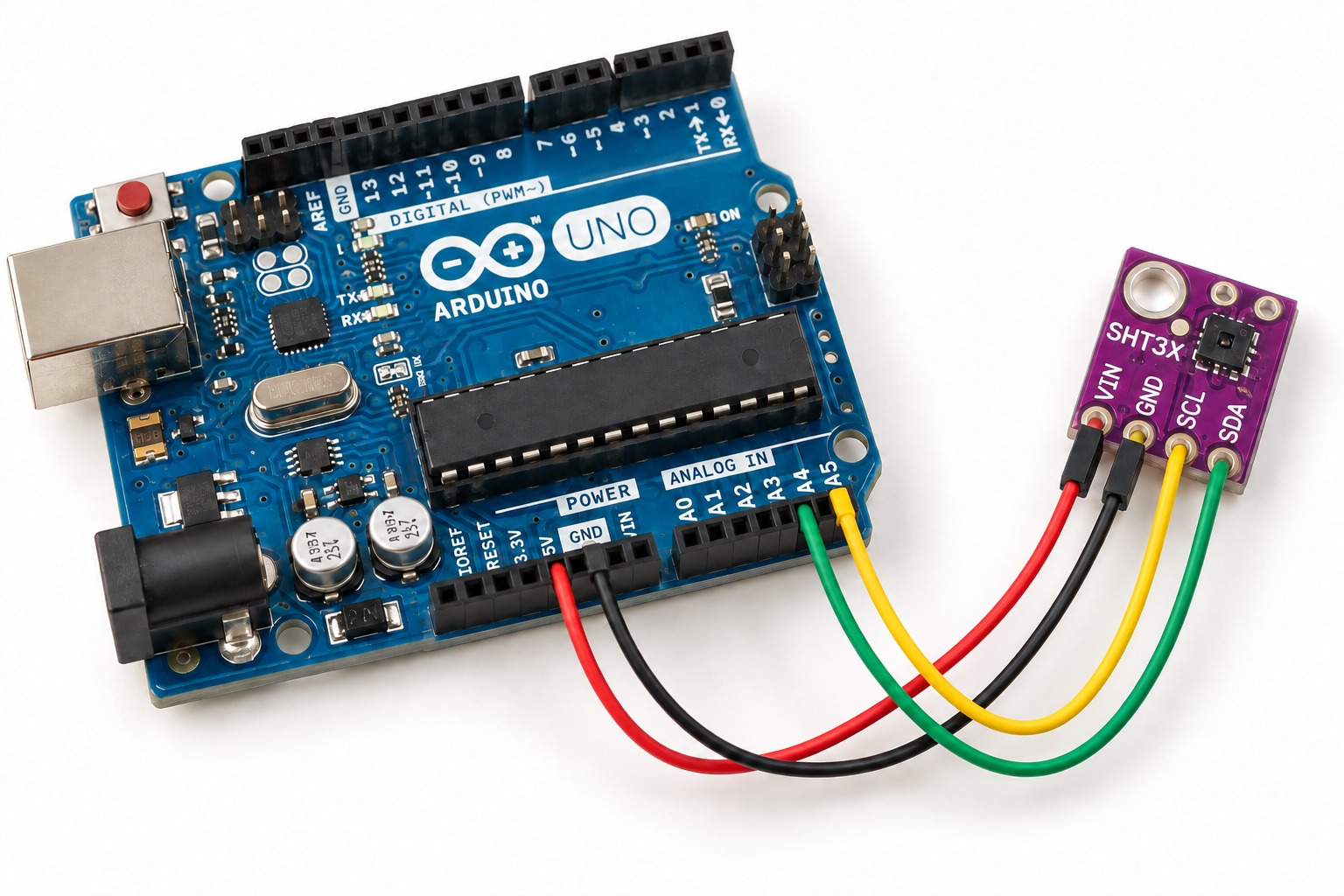
For Arduino Uno, ESP32 and ESP8266 wiring, a scanner sketch and measurement code, continue to the SHT30 Arduino wiring and troubleshooting guide. If the scan finds 0x44 but readings fail, see the transaction and CRC diagnostic guide.
How accurate is SHT30 in a finished product?
Sensirion specifies typical SHT30-DIS accuracy of ±2 %RH and ±0.2 °C over 0–65 °C for temperature. These are device specifications under the datasheet's conditions. Airflow, enclosure temperature, PCB heating, contamination, condensation and assembly can add system error. A valid I²C frame cannot prove that the sensing element is exposed to the intended ambient air.
Which SHT30 product format should you choose?
Choose the interface at the system boundary. A cabled I²C probe can still be unsuitable for a long, noisy cable; an industrial transmitter adds interface circuitry and its own performance limits. Evaluate the finished assembly, not just the sensing IC.
| Application | Practical starting format | Check next |
|---|---|---|
| Arduino or ESP32 prototype | Documented digital breakout | Voltage levels, pull-ups, address and library behavior. |
| Compact production PCB | SHT30-DIS or another board-level digital IC | Footprint, assembly, enclosure and error budget. |
| Analog controller input | SHT30-ARP or documented analog module | Output transfer function and ADC error. |
| Outdoor air sampling | Protected, ventilated probe | Ingress limits, condensation, cable length and response time. |
| PLC or long industrial cable | Documented RS485/Modbus transmitter | Power, baud rate, register map and total transmitter accuracy. |
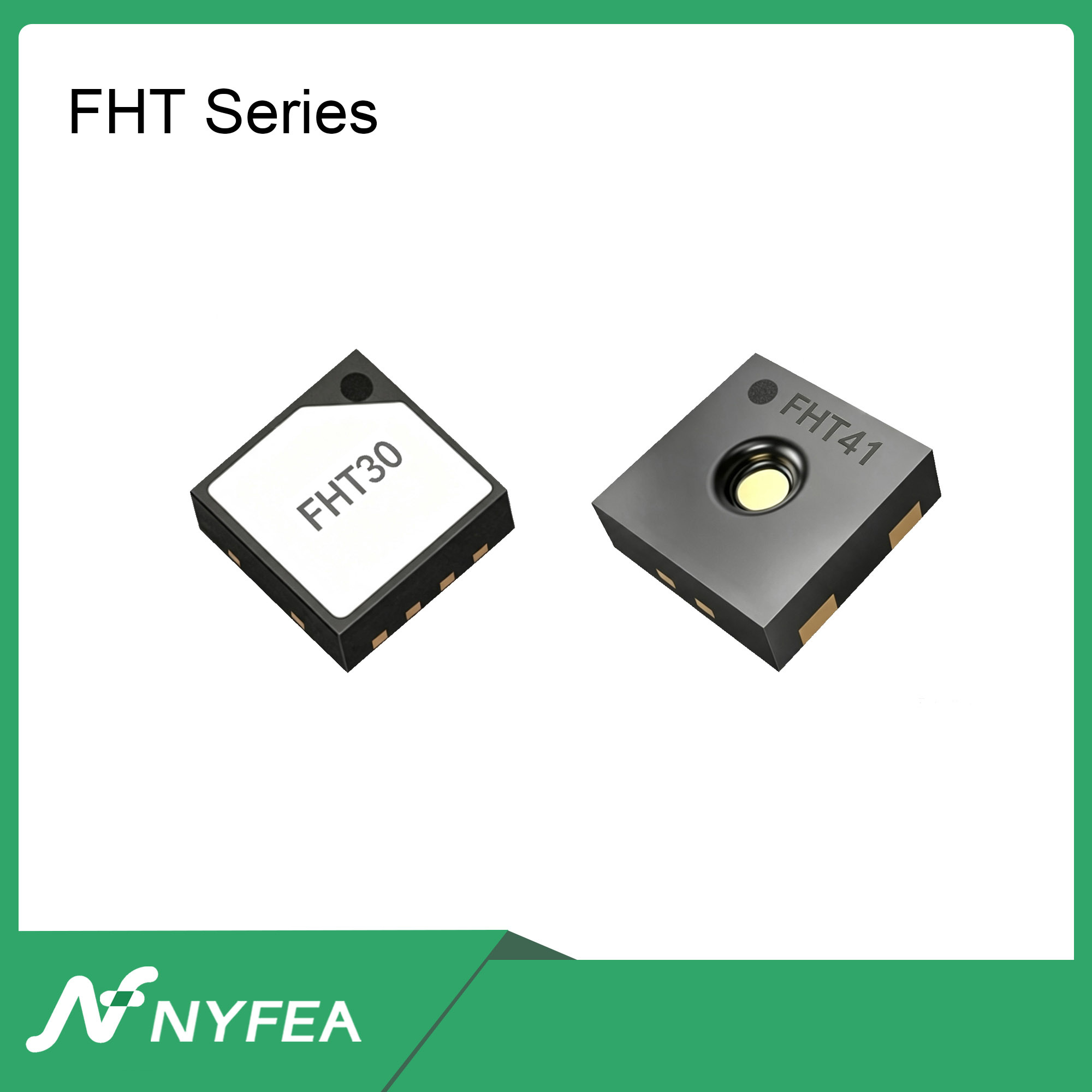
Where does NYFEA FHT30 fit?
NYFEA FHT30 is a candidate for evaluation in SHT30-based digital designs. NYFEA documents a 2.0–5.5 V supply, selectable 0x44/0x45 addresses, CRC-protected I²C data and a DFN-8 package. Those shared features start a comparison; they do not establish pin, firmware, measurement or production compatibility. FHT30 is a board-level IC, not a finished probe or RS485 transmitter. [7]
For a controlled review, send the exact SHT30 order code, schematic, PCB footprint, firmware command list, expected temperature/RH limits, assembly process and final enclosure conditions. Compare those against the current FHT30 specification and measured samples.
SHT30 sensor FAQ
Is every SHT30 module an I²C sensor?
No. SHT30-DIS is a digital I²C IC, but SHT30-ARP and some modules provide analog outputs; an industrial transmitter may expose RS485/Modbus instead. Identify the complete product's terminals and exact part number.
What is the default SHT30 I²C address?
For SHT30-DIS, ADDR low selects the default 7-bit address 0x44. ADDR high selects 0x45. A module or cabled probe may fix the address in its hardware.
Does SHT30 itself support RS485 or Modbus?
The SHT30-DIS IC uses I²C. An RS485/Modbus product can contain an SHT30 sensor and separate interface electronics; the host communicates with the complete transmitter.
Can I use SHT30 Arduino code with an analog SHT30 module?
No. I²C code expects SDA and SCL transactions. An analog module needs an ADC and the transfer function specified for that exact module.
Is an SHT30 probe waterproof?
Check the exact probe's enclosure rating and operating instructions. A protected humidity probe must allow air to reach the sensing element, and “weatherproof” does not imply unrestricted immersion.
Can FHT30 replace any SHT30 without changes?
No universal drop-in claim is supported. Compare the exact device order code, pinout, PCB, supply, commands, timing, error budget and production process before qualifying NYFEA FHT30.
Primary technical sources
- Sensirion, SHT30-DIS-B product page, accessed September 24, 2026.
- Sensirion, SHT30-ARP-B product page, accessed September 24, 2026.
- Sensirion, Datasheet SHT3x-DIS, Version 7, December 2022, pin assignment, addresses, electrical limits, accuracy and CRC.
- DFRobot, Gravity Analog SHT30 module, analog board example.
- Adafruit, SHT-30 mesh-protected probe, cabled I²C example and model-specific limits.
- Ebyte, EID041-G01S transmitter documentation, SHT30 inside an RS485/Modbus instrument.
- NYFEA, FHT30 engineering product information, candidate-device scope.
This is a document-based guide. It does not report original laboratory measurements or qualification of a particular SHT30 module, probe or FHT30 design.
Evaluate a digital sensor for your PCB
Share your exact SHT30 order code and system requirements with NYFEA for an FHT30 document and sample review.
View FHT30 technical dataContact NYFEA Engineering